






 By Cara Haberman, M.D.
Staring blankly at the yellow-and-black checkered gate in front of me, it occurs to me that it is taking a moment too long for the parking attendant to read out my total. I glance up at her and find dark, serious brown eyes searching my face. A jolt of recognition—it’s her.
A confession: This is not, in fact, the medical faculty parking deck. My residents call it “Princess Parking,” when you pay a few dollars to park in the much closer patient and visitor lot. As a rule-follower by nature, I almost never do this. Only on weekends, when it’s nearly empty anyway, and I always wear my jacket zipped up to the neck to hide my scrubs and badge, as if the parking police are going to arrest me.
In fact, the last time I parked here was a few months ago. I remember because it was the end of a particularly exhausting week. I had been up most of the night before speaking with my resident team about an assortment of unusual admissions. My list of patients that morning held the promise of a difficult day, so as I approached the hospital, I gave myself the little treat of a shorter walk by turning into the “Princess Parking” deck.
Indeed, that day spun out as emotionally draining as I anticipated. We told one mother her child most likely had cancer, and we sat and cried with her. We gave another family a life-altering diagnosis for their newborn infant. One of my patients was removed from her mother’s custody, and we listened to the accusing wails of a family being torn apart. Knowing it was the safest choice for the child did not make it any easier to hear. Another mother, terrified in the face of her baby’s illness and lacking ways to cope, lashed out and verbally abused our team. After a long, tense talk, we managed to regain a fragile trust on both sides.
As is often the case, I did not eat lunch, go to the bathroom or really even sit down all day. When I walked out of the unit hours later, I was hollowed out, empty. I had given every last bit of myself to the work of the day. When I got to my car I just sat, feeling as gray as the concrete wall in front of me. Eventually my hands remembered how to turn the ignition, my body finding the energy to drive up to the exit gate. I handed the parking attendant my ticket, and for a second, I put my head back against the headrest and closed my eyes. There were tears gathering below the surface, and I quickly blinked them back. I took a deep breath and reached for my wallet.
But as I turned back to the attendant, she was staring intently at me. She cocked her head a little to the side, like a bird, and looked at me another moment. Then without saying a word she raised the gate. I was confused for a moment. With a jut of her chin she signaled, “Go on.” Then the tears came, as I was flooded with a tremendous sense of being seen. Here I was holding it together all day long, and this woman saw in the span of a few seconds that I was barely keeping it in and so very much could use a little bit of kindness. “Thank you,” I whispered, and I drove on through.
That particular day was months ago. And here we are again, another long day, another searching look from a woman who must watch hundreds of people pass through this gate. I marvel at the deep intensity of her gaze. I imagine her studying each car, calculating how many people she can bestow her benevolence on before it might be noticed. Is she trying to decipher who lost a loved one, who received bad news, who had the worst day? All this goes through my mind in a split second, and I remember that I did not, by those measures, have anywhere close to the worst day. A hard day, to be sure. But not the worst. Someone else may need her gift today. So I summon a little smile, brighten my eyes a bit, and say, “Good afternoon.”
Her gaze softens suddenly, then darts away. Her stance shifts from Bountiful Goddess of the Parking Deck to simply Parking Lot B Attendant. “That’ll be four dollars please.”
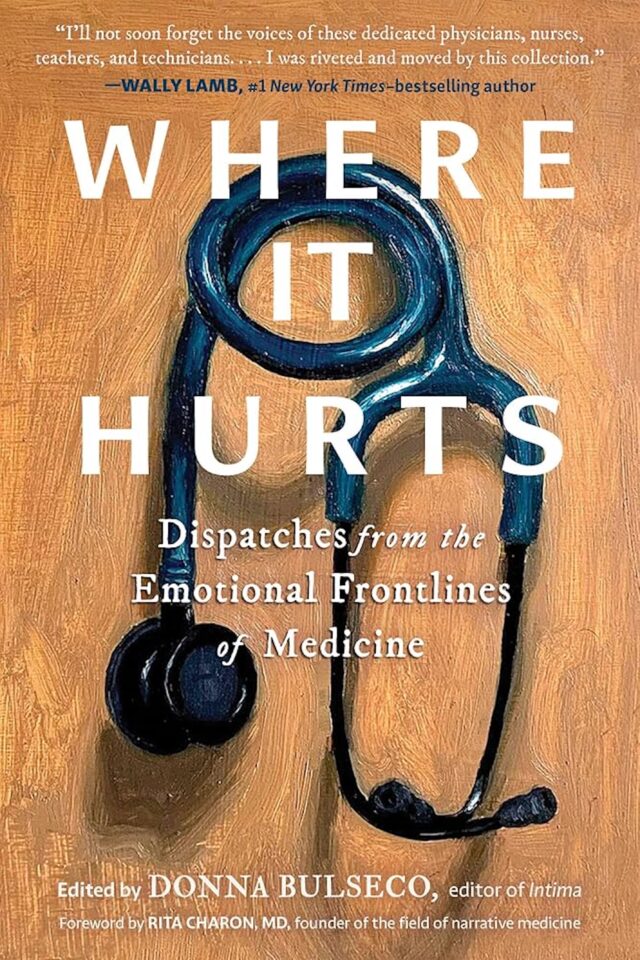
Cara Haberman is an associate professor of pediatrics at the Wake Forest School of Medicine in Winston-Salem, North Carolina. She uses narrative medicine to foster compassion and teach others about the heart of medicine. Excerpt from Where It Hurts: Dispatches from the Emotional Frontlines of Medicine edited by Donna Bulseco © 2026. Reprinted by permission of the publisher, The Experiment. Available everywhere books are sold. theexperimentpublishing.com