






By Jenna Lebovits
What if you could hack your brain? Not in the dystopian-AI-sci-fi sense, but in a totally real, targeted way, gently reactivating the neural circuits shaping how you think, feel and function day to day?
Depression is rampant. The leading cause of disability worldwide, it affects an estimated 332 million people. For many, especially the 30 percent of those living with treatment-resistant depression, the quest for lasting relief is a long, winding road of trial and error, often with conventional options falling short.
Transcranial magnetic stimulation, or TMS, offers a different path. FDA-cleared since 2008, this noninvasive, medication-free therapy uses painless magnetic pulses to stimulate the dorsolateral prefrontal cortex—the brain’s executive control center—where depression, ADHD, food cravings and impulse control issues reside. In cases of depression, this region is often underactive. By targeting this area, TMS helps to “wake up” parts of the brain that have gone quiet.
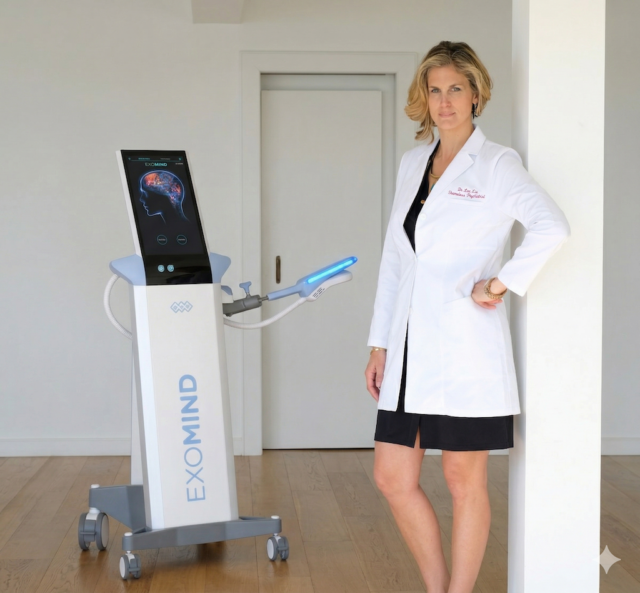
The technology itself isn’t new—it’s backed by a strong body of research supporting its efficacy—but in 2025, it received an upgrade. The sleeker, simpler Exomind builds on traditional TMS with shorter protocols and expanded applications, reaching more people. Once reserved for treatment-resistant depression and OCD, this next-gen system can now address anxiety, brain fog and more, with FDA clearances spanning MDD, OCD, certain migraines, nicotine dependence and specific anxiety disorders.
Purist speaks with Dr. Lea DeFrancisci Lis, double board-certified adult and child psychiatrist and assistant clinical professor at New York University School of Medicine, on how TMS works, who it’s best suited for, and what it signals about the future of mental health care.
PURIST: Tell us a bit about your work, and how transcranial magnetic stimulation functions in the brain.
Dr. Lea DeFrancisci Lis: I’m a psychiatrist in the Hamptons who is transitioning my practice to focus more on integrative mental health, which means using other effective treatments besides just medications—that’s why I am so excited by TMS. The brain works on electricity, and TMS harnesses this by using magnetic fields (like an MRI does) to create electromagnetic currents.
An applicator is placed against the scalp, where it delivers a small, painless electrical current into the brain tissue. This stimulates neurons, increasing their activity to more stable, healthy levels. I’m truly enthusiastic about the new Exomind TMS machine. Unlike other machines, it’s easier to operate, and features specialized coils that deliver more targeted energy to the right part of the brain, with the benefit of AI-driven, real-time brain mapping to understand and personalize the treatment to your brain, compared to traditional TMS.
The best part about Exomind is that it has a sleek design, unlike the other TMS machines, and it has reduced treatment time. Instead of months, patients often feel improvements within two to six sessions. It’s like a jump start for your brain—it can cause neuroplastic changes without medication. It is incredibly exciting for me to be able to offer this to patients.
Is TMS best utilized for people with more generalized depression, or only major depressive disorder?
LDL: TMS is highly effective for depression, targeting the dorsolateral prefrontal cortex, a region associated with mood, to improve regulation and alleviate symptoms. When combined with ketamine-assisted psychotherapy for treatment-resistant depression, it’s a dynamic duo.
How about OCD and other mental health conditions—can modern TMS be effective in treating those?
LDL: Absolutely. While it helps with mood, TMS is also being used for OCD and binge eating. We are even seeing benefits in more subtle areas, such as perimenopausal brain fog. Athletes like Serena Williams and Tracy McGrady use Exomind for anxiety and focus—I even use it to deal with my own work stress and brain fog. It’s amazing for helping restore maladaptive sleep patterns, acting like a brain tuneup to guide your mind into an optimal state.
Who is the ideal candidate for TMS, and how do providers determine when it’s time to consider it as part of a person’s treatment plan?
LDL: I believe modern TMS, like Exomind, can be used for almost anyone. This includes people with mental health conditions like depression and anxiety, those seeking help with binge eating and weight loss, perimenopausal women suffering from brain fog, and executives, professionals or athletes looking for improved focus or relief from burnout. The only people who are generally not candidates for TMS are those with risk of seizures or stroke, or those who have a pacemaker.
The research shows that overall, TMS is described as noninvasive and well tolerated. What is the typical patient experience like, session to session?
LDL: Straightforward and comfortable. When you come to the office, I begin by placing the applicator on your head. We next locate your motor cortex, where a small pulse causes your hand to move. Then the machine uses its AI brain mapping, and we set the program based on your specific needs. You simply sit for 28 minutes. The feeling is like a tapping on the head; it doesn’t hurt. The most common side effect is just an occasional headache. We recommend six sessions for most people. The most common misconceptions are that it would hurt or cause damage to the brain, which it does not.
Would you consider it an emerging modality?
LDL: TMS has been well studied and around for a very long time. What makes it feel new right now is the six-session protocol, which has made it much easier to use. What is also shifting is how we are using it for mental wellness and brain health. We also have a better understanding that it can be a proactive part of a wellness and longevity program to help you live a healthier and happier life. hamptoninsight.com
Dr. Lea DeFrancisci Lis is a double board-certified adult and child psychiatrist trained at New York University School of Medicine. Throughout her career, Lis has advocated for better care for children at both the professional and political level.