








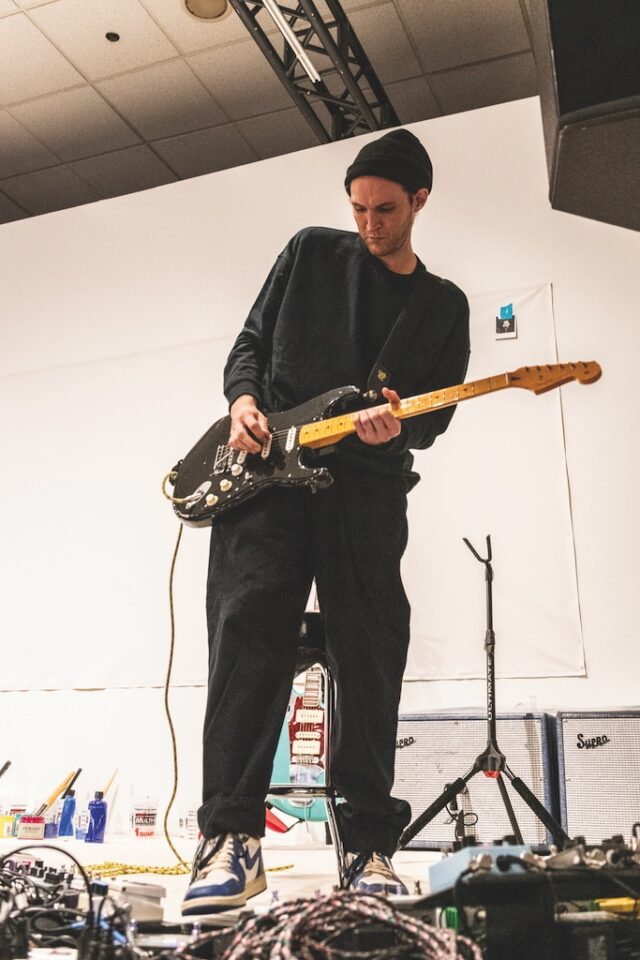
By Jenny Landey
Josh Klinghoffer started playing guitar in constant motion, disappearing into the sound, because he was shy. “It wasn’t ‘me’ anymore,” he says. “It was the guitar.” That instinct has carried him from a quarter of the creative unit in Red Hot Chili Peppers to a supporting role in Pearl Jam, through a Rock & Roll Hall of Fame induction he still calls “something of a technicality.” These days, he reads 15 books a year, meditates with the Waking Up app and goes to therapy twice a week—less in pursuit of answers than in the practice of paying attention. Fresh off performances with Chad Smith and Andrew Watt, and with A Drop in the Ocean—his fourth album under the solo recording name Pluralone—out now on Org Music, Klinghoffer is in one of the more active stretches of a career defined by movement.
PURIST: Watching you play recently with Smith and Watt at a performance in East Hampton, there’s something almost hypnotic about the way you move with the guitar. It feels like an extension of your inner world. Has music always been that immersive for you?
Josh Klinghoffer: I think it started because I was incredibly shy. Before you’re performing for people, playing music is a completely different thing. I developed this very kinetic way of playing where the guitar became the thing you were looking at, not me.
Even during my years with the Chili Peppers, where so much energy was required onstage, I felt like if I could turn movement into something engaging for the audience, I was doing my job. Maybe there was some psychological thing I was working out, but it’s always been genuine. If I’m having fun, you can tell. If something’s wrong, you can tell that too.
Your new album A Drop in the Ocean is stripped down to just you and an acoustic guitar, a departure from the multi-instrumentalist approach you just mentioned. What made you want to pare everything back this time, and did that change how you approached songwriting itself?
I felt like I’d made three albums that were more full-band sounding. This time, in an effort to strip things down to more of the essential elements. I wanted to create an album that felt smaller and more like one person making it, which it is. I am far more interested in hearing a person these days, rather than a product or production.
You’ve lived inside two legendary bands, Red Hot Chili Peppers and Pearl Jam. What stands out to you about how each approaches creativity and collaboration?
My role has been different in each band. With the Chili Peppers, I was one quarter of the creative unit. With Pearl Jam, I’ve been much more in a supporting role.
What’s interesting is how much continuity there is between them. The Chili Peppers took Pearl Jam out on one of their first tours in 1991, and Pearl Jam absorbed a lot from the Chili Peppers as a touring band. The crew culture, the way things are organized, even some of the backstage language, it feels eerily similar.
Where they differ is in how they approached their careers. The Chili Peppers continued pursuing radio and younger audiences, while Pearl Jam focused more on their live community and fans who had already been with them for decades. When you’re onstage with Pearl Jam, you feel that history. Many people in the audience have been coming for 30 years and now they’re bringing their kids.
You became the then-youngest inductee into the Rock & Roll Hall of Fame at age 32. Looking back, what does that milestone mean to you now?
I happened to be a current member of the Chili Peppers when they were inducted, and I was grateful they included me. But I never felt like the work that earned that recognition was mine alone. Success has always been a funny concept for me. When I was 17 and becoming friends with musicians I admired, I remember thinking, I’ve made it. That already felt like success.
Now I still have days where I think I’ve accomplished very little, and other days where I can look back and feel genuinely proud of what I’ve done. I think that’s probably just part of being human.
Music has the power to regulate emotion, create connection and heal. What does making music do for you personally?
Escape. It’s always been an escape. These days I spend so much time writing and recording that I’ll realize I’ve basically been listening to myself for a month straight because I’m in the studio every day. It’s also incredibly therapeutic. I’m grateful that I can create something out of thin air, escape into it myself and hopefully share it with other people. Ultimately, if you can make the world a little better through what you create, I think that’s the goal.
Pluralone’s new album, A Drop in the Ocean, is available at orgmusic.com.
Explore more in Entertainment at The Purist.
Never miss an issue—join The Purist community.