








By Lauren Willett
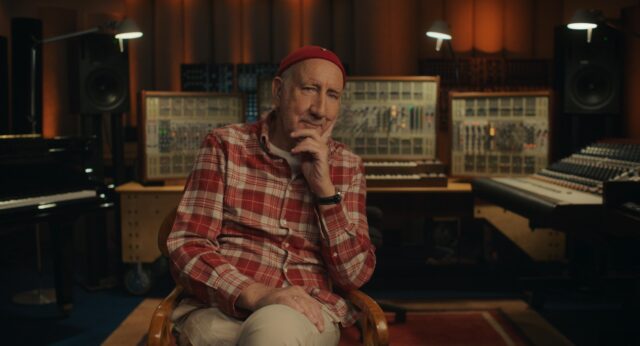
PURIST: Frank and Nigel, you each came to this project with a different relationship to Pete Townshend and The Who. What first brought the two of you together for Pete Townshend: Behind Blue Eyes, and what did you each see in his story that made you want to tell it?
FRANK MARSHALL: I’ve always liked The Who’s music but had never heard of Lifehouse. So, when Nigel came to me and said, “There’s this unfinished sequel to Tommy,” I was really curious to find out what that was all about.
NIGEL SINCLAIR: Frank and I have worked together on a number of projects, so we had a great working rhythm. And I have had a long friendship with both Pete and Roger [Daltrey], so when we talked about it, it made sense for us to direct it together. What turned out to be so great was that Pete had reached a point in his life when he was ready to look back on his creative process and really open it up. That drove the project and gave us a depth of insight beyond anything we could have imagined.
The film began with Lifehouse as the main focus, but eventually grew into a much broader portrait of Pete as an artist. At what point did you realize that understanding why Lifehouse mattered so deeply to him meant going back further—to his artistic roots and desire to be seen as more than a rock star—and following those threads throughout his life?
FM: As we started the interview process with Pete, it became apparent that, in order to understand what he was trying to achieve with Lifehouse, we would have to go way back to the origins of what influenced him as an artist.
NS: The extraordinary thing is that Pete had this idea of Lifehouse as an attempt to take his creativity to another whole level after Tommy which was, from the standpoint of 2026, brilliant and far-sighted. At the time, so many of the ideas that seem obvious to us now were then confusing to both the band and others, and it stumbled on that. In a number of different ways, that feels like it was a defining point in Pete’s creative evolution. As Frank has explained, to understand the power of this idea to Pete, you have to understand his evolution as an artist and what hopes it was meant to fulfill.
Townshend experienced Lifehouse as a profound creative failure, yet ultimately produced some of The Who’s most enduring music as a result. How did that tension between creative failure and extraordinary creative output influence the way you constructed the film?
FM: That irony became the spine of the story, cutting between Pete’s private sense of failure and the public story. We used his interviews, notes, demos, and drafts of the script, and how they became the songs in Who’s Next, giving us “Baba O’Riley,” “Won’t Get Fooled Again,” and “Behind Blue Eyes.” It’s like the thing you feel you failed at can still be the most important thing you ever made.
NS: Pete is the ultimate reluctant rock star. As he explains in the film, his personality developed in two parallel directions—the brilliant musician, guitarist, innovator, and performer who, alongside Roger and the others, drove this band to the heights of the founding of rock and roll; and the other side of his nature, the thoughtful writer and recording genius whom you could almost describe as introverted.
And, of course, the battle between these two sides became central to Pete’s public persona—which used to puzzle me as a young fan. What on earth was the problem being Pete Townshend, as we all understood him? We had a great writer in our colleague, Cassidy Hartmann, unraveling this, and I hope the film answers that. His decision to leave rock and roll altogether and go work for the world’s top literary publishing house, Faber & Faber, was shocking then but almost seems inevitable as you follow the story now.
One of the fascinating ideas within Lifehouse was Pete’s spiritual connection to bringing people out of isolation and into a collective experience through personal data, advanced technology and music—an idea conceived more than 50 years ago that we see reflected in modern music experiences today. Did making this documentary change the way you understood Lifehouse—not just as an unfinished rock opera, but as an idea that may have arrived before its time?
FM: It definitely was an idea ahead of its time, and hearing Pete talk about where it came from made me look at Lifehouse differently. Pete wanted data to lead people toward a universal chord or note, to have technology and music liberate people and join them together. Amazingly, we are seeing that happen today.
NS: What I came to understand from working on this was the roots of the different themes in Pete’s life—his desire to communicate with an audience at a much deeper level than playing songs to vast numbers of people and giving them great joy. His humbling experience was that whatever was going on between these huge audiences and the four people in The Who, he had to look inside himself and find meaning beyond the momentary uplift. As we say in the film, he may not have made that connection through the Lifehouse experiment in the way he wanted to, but he did make a lasting connection through the music. And we see that unfold in the footage we have found.
The film follows Pete through enormous creative ambition, disillusionment and, eventually, a different relationship with both his work and The Who. Looking at that full trajectory now, what do you think his story reveals about the relationship between an artist and the work they feel is their duty to keep alive?
FM: It’s sort of like a question he hasn’t finished answering. Keeping it alive is a way of saying I still believe it was worth attempting, and in Pete’s case, time has mostly proved him right.
NS: Part of what makes Pete’s approach to life and creativity so singular is his genuine belief in the artist’s role in society. As Brian Eno says in the film, a true artist will set an idea in motion and let it unfold however it may. Lifehouse crystallizes that—even though the initial concept was never fully realized, the fruits of that labor and time have left an indelible mark on culture.
You are telling a story rooted in one of rock music’s most consequential eras, but its themes of creative failure, struggles with identity, human connection and reinvention go well beyond The Who. What do you hope someone who may not come to the film as a Pete Townshend or Who fan takes away from his story?
FM: How complicated and intellectual Pete is and how he saw today’s world coming back in 1971. He described people living alone inside a network, their personal data turned into something that could either trap them or free them. Sound familiar?
NS: Based on our interviews, Pete is still preoccupied with reconciling the contradiction between the exuberant rock star and the thoughtful, internal writer. But there is another side of this story—Pete Townshend was, as we have said before, one of the avatars that took rock and roll from being a form of popular music and turned it into an anthem and a call to action for a whole generation and many others. A select group—Bob Dylan, John Lennon, Ray Davies, and maybe David Bowie together with Townshend—gave this music, the lyrics, the performance, and even the visual art that went with it the strength to become an identity for millions and millions of people. As “The Times They Are A-Changing” changed the narrative, the Tommy double album emancipated rock from the three-minute song.
Following the film’s world premiere at Telluride, Pete Townshend: Behind Blue Eyes will have its East Coast premiere at the Hamptons International Film Festival. What has it been like to finally experience the film with audiences, and what are you especially looking forward to about bringing Pete’s story to the Hamptons?
FM: I always love seeing the film with an audience, and I’m excited for them to discover this amazing story of an artist, with the added plus of hearing great music. There’s nothing better!
NS: Much like the way Pete describes the collective effervescence of live music in uniting people in a shared space, a similar energy exists in getting to see a film with an audience, and we are so thrilled for it to have its moment here at the Hamptons International Film Festival. hamptonsfilmfest.org
Explore more in Entertainment at The Purist.
Never miss an issue—join The Purist community.