








By Lauren Willett
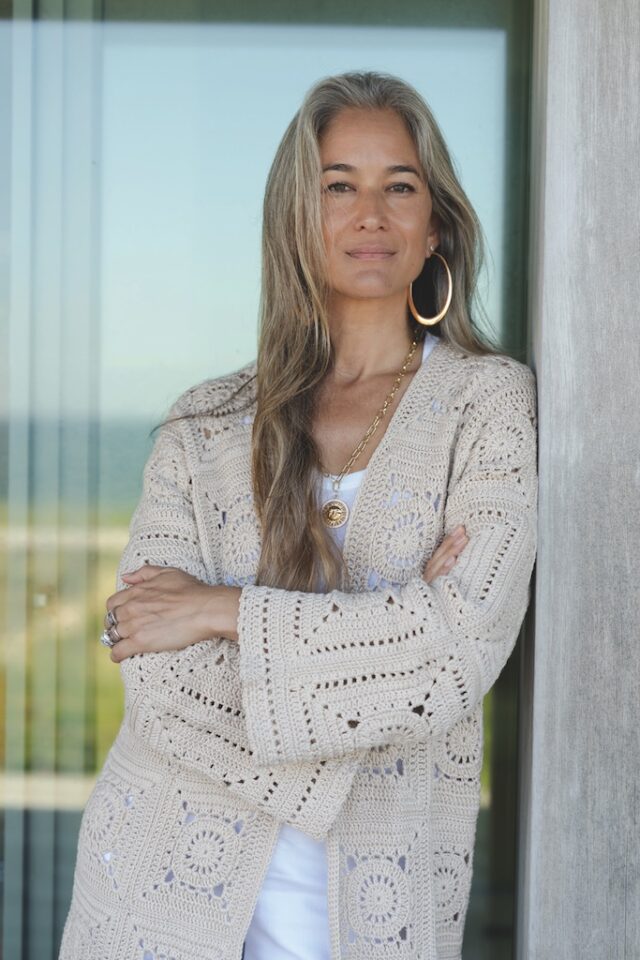
In a world filled with endless noise and a constant feeling of rush to the finish line, it makes sense that people are looking for spaces in which they can slow down, connect and create. If you look back in time, people have always turned to each other to find community in their hobbies. “Women have been stitching around a table for generations, sharing stories, exchanging ideas, receiving and giving gentle support,” says NYC community builder Vanessa Cornell.
A student of East Asian studies at Harvard, Cornell went on to a career at Goldman Sachs, following, by her own admission, every external signal of what a promising young woman should want. As a kid, she’d spent afternoons in the Woolworth’s aisle choosing yarn and beads, simply for the joy of making something—and it took her years to admit she missed that. Vanessa’s Stitch Club was the result: a place where community and craft could finally share a home.
Community building, for Cornell, began as something closer to a survival instinct, a way of finally letting herself be known after years of holding everything at arm’s length. “I became dedicated to creating spaces for people to do exactly that: to feel safe to unmask and let themselves be seen,” she says of the work that followed. That impulse to help other women feel safe enough to do the same is the architecture behind everything she has built since. Stitching gives that connection a natural place to begin, allowing conversation to unfold while the hands are busy and the mind begins to soften.
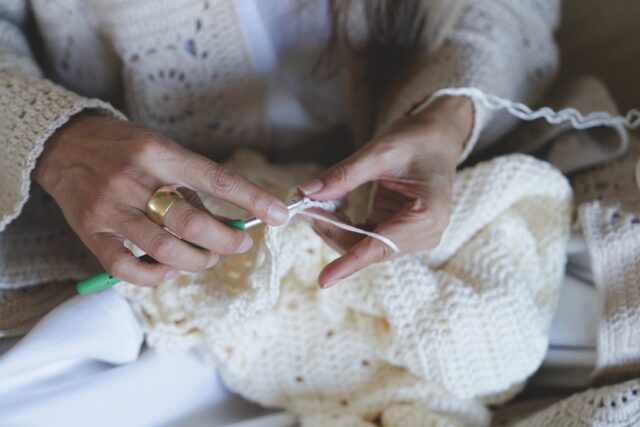
It’s a fitting moment for the instinct: handmade luxury is having something of a cultural reawakening. For decades, luxury has been defined by the reassurance of a factory’s “perfect” process. Now, in a market flooded with things built to be replaced, value has started to shift to the opposite: the noticeable touch of the maker, the slight imperfection that proves a person, not a machine, put the heart and effort into making this. A handmade piece carries the fingerprints of the hours spent on it, and Cornell believes those hours transfer something real.
Cornell sees crochet as one of the more accessible forms of mindfulness, and a way to ease anxiety that suits a distracted culture better than meditation does — it doesn’t ask anyone to sit still and empty their mind, which is often where meditation falls apart. It asks for light, repetitive attention instead. “Without grasping or gripping, your mind lightly settles on the rhythm and repetition,” she says. It’s not a project that can be rushed. Making something with your hands can be a way back to yourself, and doing it alongside other people can be a way back to each other.
Cornell has built a structure around that discovery, generous enough for anyone to walk into. Her monthly virtual stitch gatherings welcome beginners and experts alike, creating a space outside of home and work where creativity and kindness rule. “I love carving out a space for adults to be in their childlike wonder, where they can simply dream and investigate colors and shapes, surrounded by others who are as enthusiastic as they are,” she says.
Whatever brings someone to their first Stitch Club gathering, the pleasure of creating alongside others gives them a reason to return. Their hands are busy, their guard is down, and they remember what it feels like to be part of something. Asked what that something is, Cornell says simply, “In a word, joy.” vanessastitchclub.com
Explore more in Wellness at The Purist.
Never miss an issue—join The Purist community.