







by Ray Rogers
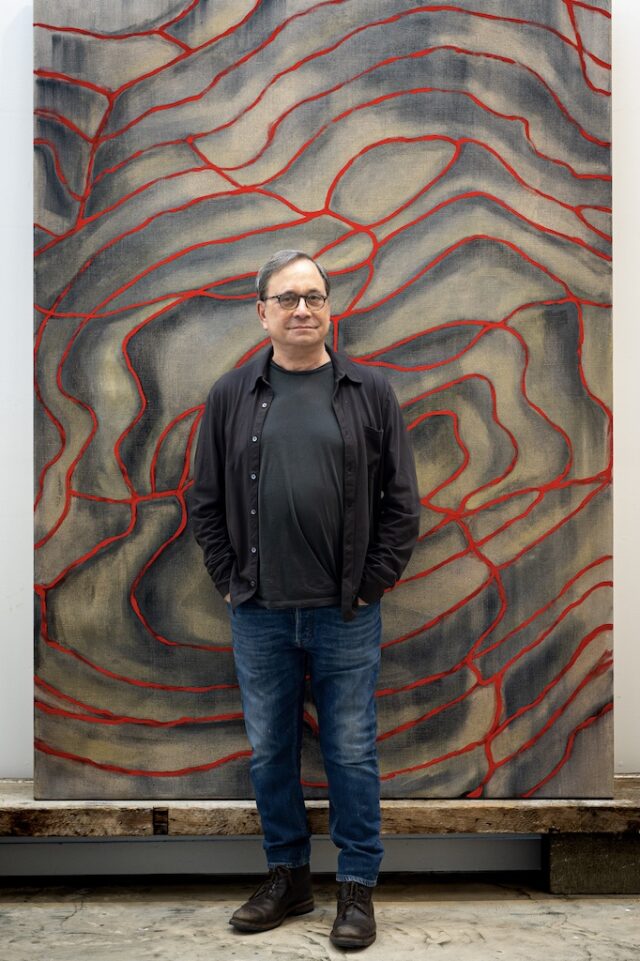
“Don’t mind him—he always barks at new people,” Ross Bleckner calls out, making his way from the pool at the far end of his property to greet me at his home studio. Julius, his wire-haired dachshund—who looks like a little old man—keeps careful watch over our two hours together, never letting Bleckner out of his sight. He’s always kept dachshunds in tow (“I’ve had many of them, one after the other—I love them”); even his welcome mat has an illustration of an elongated wiener dog.
Hundreds of tubes of oil paint clutter the tables inside the cavernous, 4,500-square-foot studio, crinkled to varying degrees—Titanium White, Granite Gray, Transparent Orange—beside cans packed with brushes of every size. Stretchers with large-scale oil-on-linen works line the walls. An archive room holds binders and scrapbooks of inspiration: notes, cutouts, quotes clipped from the Times.
When Bleckner found this property, it was derelict. The artist Ibram Lassaw, a metal welder, had bought 45 acres here in the 1960s for $250 an acre, to avoid having neighbors. “There was a tiny little house right there and a tiny little studio,” Bleckner says. No one had lived there in 10 years by the time he took it over—Lassaw died, his wife died, and the daughter, whose godparents were Willem and Elaine de Kooning, didn’t want it either. “It looked like Vietnam,” he says. “Every tree—the canopy had to be raised because the vines were killing it.” When he rebuilt, his architect was able to save the fireplace’s original dramatic flue welded by Lassaw.
He’s been on this spot in Springs since 2019, the year he built the studio—and he never really left. The property sits just down the road from the Pollock-Krasner House, where Jackson Pollock and Lee Krasner made some of the 20th century’s defining paintings. COVID kept him there through 2020 and 2021; he stayed nearly four years. He’s since purchased the neighboring plot and turned the house on it into an informal residency, two studios and two bedrooms, hosting young artists by word of mouth. “It’s nice for me to have some creative energy around,” he says. “Not just be alone in my studio. It has to be the right fit.”
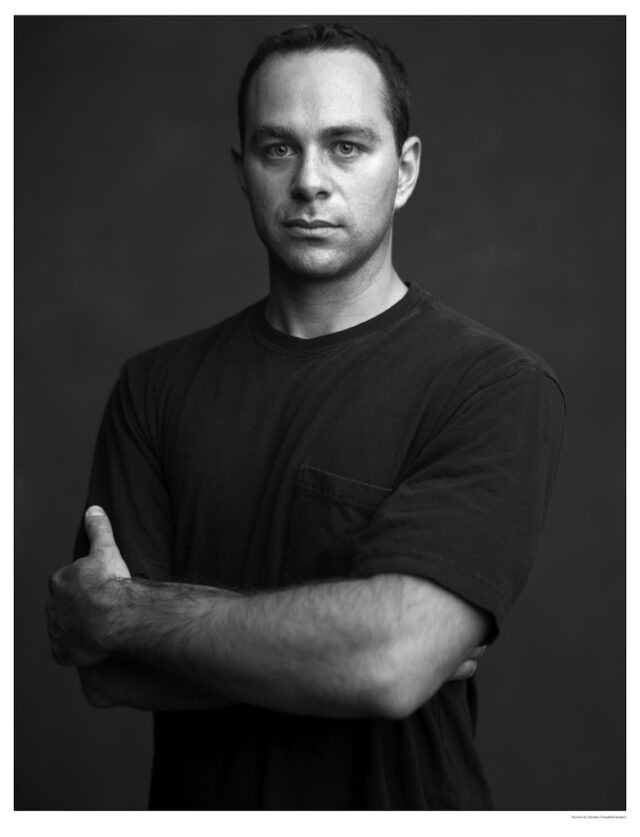
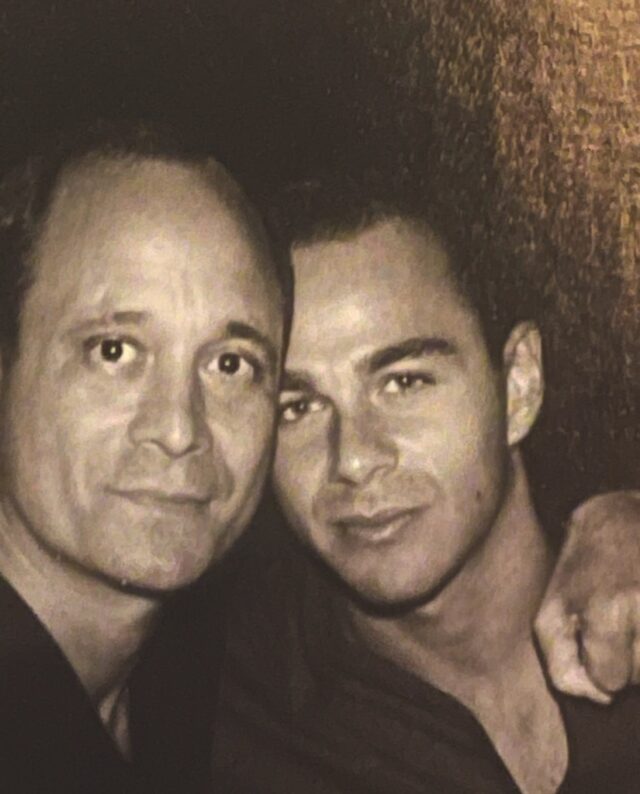
For years, the person filling that space beside him wasn’t a young painter in residence, but his partner of three decades, the artist Eric Freeman.
They’d lived together for years at a Sagaponack beach house once owned by Truman Capote, which Bleckner had heavily renovated. Neither wanted to stay once it came time to leave the city. The area, he says, looked completely different when they first arrived: “It almost looked like Fire Island, beach houses from the ’70s. But they all got knocked down for 40,000-square-foot mansions. It was noisy.” They found this place in Springs by accident, through the General Store: the seller, Lassaw’s daughter, would only sell to another artist. She called Freeman. “He called me and I came that day,” Bleckner says, “and I said, OK, I’ll buy it. It was just property, really, with a falling-down little house.”
Freeman is still everywhere here—and not just his works placed prominently in the home’s living room. Searching his phone for a photo, Bleckner mentions that today would have been Freeman’s 56th birthday—he’d posted a tribute on Instagram that morning: Freeman with one of their beloved dachshunds in his arms. “Even my hidden folder is just things I don’t want to see every time,” he says. “Like Eric is in my hidden folder. He was my partner for 30 years. He was beautiful.” Sometimes a car pulls up the driveway and, for a moment, he feels relief and joy, thinking it’s Freeman. Then he remembers. Freeman died of an accidental drug overdose in 2021.
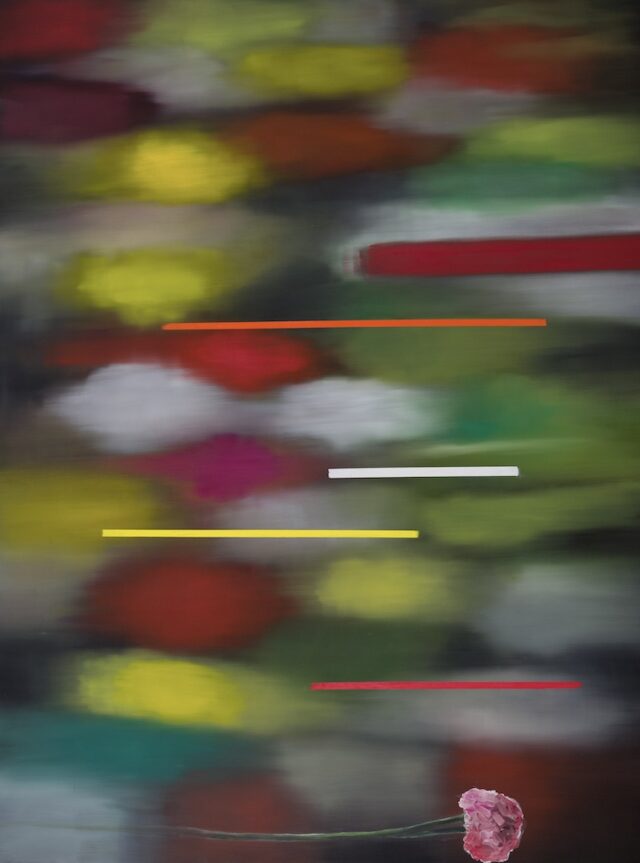
Bleckner is honoring Freeman’s creative output posthumously with two simultaneous Guild Hall shows, Bleckner’s Never The Less, paired with Eric Freeman: The Volume of Color, both up through October 25, an effort that’s been hard both emotionally and logistically. In the haze of grief, Bleckner let the police take Freeman’s laptop before he could trace the locations of his partner’s art; with no will, the computer went to a father Freeman “didn’t have any relationship to,” Bleckner says with a sigh. He’s been painstakingly recovering the paintings ever since. “Now I’m finding them slowly,” he says. “And I have enough to do a show.”
Asked what he wants people to understand about their years together, now that Freeman’s work hangs beside his own, Bleckner pauses. “Grief is just such a mysterious, elusive feeling,” he says. “You just don’t know when it’s going to happen. It’s still happening.” He could be walking down the street and start to cry. “My life was arranged so that Eric would live longer—he’d be here when I’m not. He wasn’t supposed to die before me. So it was kind of a shock, and still is.” He built this studio to be winterized, he says, so he could stay through the cold months. He doesn’t. “Because Eric’s not here.”
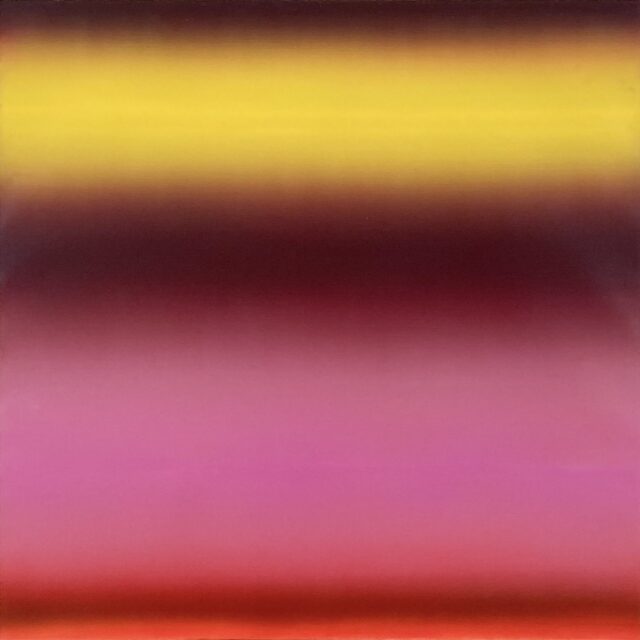
The Guild Hall pairing, Eric Freeman: The Volume of Color, is Bleckner’s attempt to make sure Freeman gets his due. Freeman came from a modest family—his parents were teachers, and he’d gone to Stuyvesant High School—with no clear sense of what he wanted to do until Bleckner saw something in him. “I just knew he was an artist,” Bleckner says. “It was his sensitivity, the way he looked at things.” He sees their work less as opposites than as variations on the same subject. “His work was about light and my work was about light,” Bleckner says. “My work is a little darker than his, so he was the light. I was like the dark and light.”
He doesn’t hesitate when it comes to what he wants people to take from seeing the two bodies of work together. “I thought he was a much better painter than I was,” he says. “His paintings had his soul in them and it translated through light—moving light, inner light, surface light… I just want him to be remembered. He wasn’t that well known, because he didn’t want to be.”
It isn’t the first time Bleckner has made work in the shadow of loss. His father died of cancer, and in the 1980s and ’90s he lived through the AIDS crisis firsthand—15 years as president of the AIDS Community Research Initiative of America (ACRIA). “That’s actually when I was the most social,” he notes, “because I was responsible for raising money.” Looking back on the cell paintings that period produced, he’s clear-eyed rather than pained: “They were actually very illustrative. They were hardcore. They weren’t decorative at all.” Some of his work is more decorative—“the flowers and all that shit”—but the cell paintings belong to a different, more conceptually grounded strain. “I actually see myself as a conceptual painter,” he says, “by the range of what I’m trying to do.”
That range is on full display in his studio today, with a cluster of works that will be shown at his show at the Petzel Gallery in Manhattan this September, in which cells, brain scans and organs recur as motifs. “These are all body-related,” he says of one painting, gesturing at arteries and veins rendered around an absent heart. “It has a lot to do with flowing around that beating thing.”
He also turns to the masters, riffing off their work as source material rather than working from life. “That one’s a Manet,” he says of a large canvas leaning against the back wall, his own variation worked up from the original as a starting point. Nearby hangs a “ghost from El Greco”—one of the master’s robed figures, the robe itself left unpainted, leaving only the form it once concealed. The effect is unsettling: a silhouette hollowed out, more X-ray than portrait, as if the robe had simply evaporated. A third canvas riffs on Matisse, dancers layered ghost-like into the composition. He started out wanting to work like Mark Rothko, he says—not to mimic him but chasing the same idea: that “painting can be expressive of feeling.”
That search is most visible in a canvas he has been circling for two years: an attempted wall of rocks reaching into the sky. “The rocks aren’t rocky enough,” he decided. To fix it, he painted the molecular structure of rock right over the image, turning the whole thing into what he calls “a ladder to heaven.” Though he admits, “I don’t believe in any of that shit anyway. But it’s OK if my paintings do.”
It’s a striking admission from an artist so often described in spiritual terms: The transcendence isn’t his—it’s the viewer’s, and he’s simply willing to let it in. “The transcendent quality is that they are looking for it,” he says. “I’m not religious…spirituality to me isn’t about something organized. It’s really about humility and kindness.” Even though he doesn’t like to admit it, all of his paintings are about trying to get to heaven, he says. “I know I’m not going there. I know there is no such thing, but in visual language it’s a beautiful effort to me.”
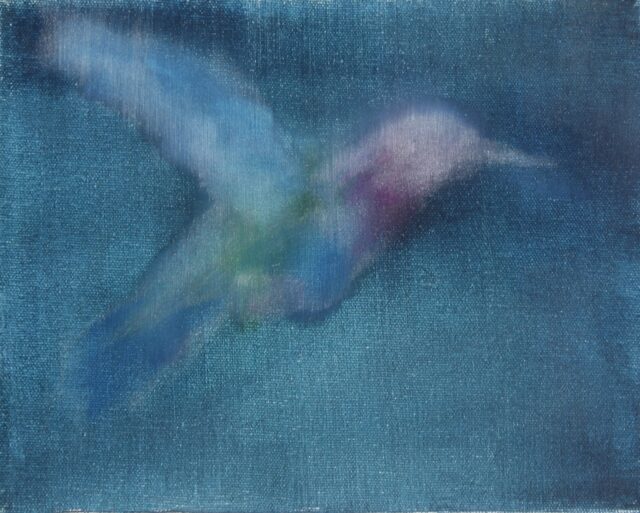
That same searching continually sends him back to meditation. “I’m getting back into it. I was lapsed,” he says. A few years ago, he spent a week in silence at Upaya Zen Center, a retreat in Santa Fe led by Roshi Joan Halifax. The first days were rough. Halifax set him straight: Nobody there was thinking about his meditation. “They’re deep into their meditation. They don’t even notice you,” she told him. His mind slowed down after that. Does it change how he works? “It does,” he says. “The perspective of Buddhism is a loving perspective. it’s just about watching how your mind works.”
That awareness of time passing has been with him since he was young. He started reading obituaries at 19, in art school—“it’s a Buddhist thing to remind yourself that time passes fast,” he says. “There’s a humility to it, that we’re just specks in a big cosmos.” The impulse, he says, traces to something more personal than doctrine: a lifelong anxiety, oddly paired with sociability. “People scare me,” he says, “which is why a lot of people become artists. You don’t have to deal with people, and who you are is read through a scrim, which is the canvas you hold in front of you.”
Bleckner is one of the most celebrated painters of his generation. At 45, he became the youngest artist ever given a mid-career retrospective at the Guggenheim—a distinction that still stands three decades later. And yet he doesn’t feel like he’s arrived anywhere. “I don’t feel like I’m at a point in my career,” he says. “I feel like I’m just getting started. Like I’m an emerging artist, and I have a lot to prove to myself.” That urgency, he admits, is also what makes him a workaholic.
Studies for a new painting sit stacked below the larger canvas nearby—not experiments, he says, but confidence-building. “Not every artist, but some artists actually work on their confidence. I just don’t have it right away.” Whether he likes his own work is another matter—the answer isn’t a simple yes. “My insecurity is my insecurity,” he says. “I feel good but not always…I don’t know if I can or can’t, and that’s also not for me to decide.” He’s made peace with the odds: “I always say, just assume 50 percent of people don’t like it and 50 percent do.”
That math gets harder when the audience is a home one. Never The Less, he admits, feels “scary” in a way his overseas shows don’t. “If I have a show in Germany, I go for the opening and I don’t know anything—they’re speaking German.” Here, there’s nowhere to hide. “I feel like if everyone doesn’t like it, I’ll see it, I’ll know.”
If anything, he leans into the not-knowing rather than away from it. “None of my ideas are definite,” he says, “and I like that sense of ambiguity.” It’s why he cleans his own studio each morning rather than leaving it to an assistant: “I want to start every day with freshness and my mind clear.”
Today in that studio sits a scale model of the Guild Hall galleries, filled with miniatures of the works that will hang there: major canvases spanning his career, alongside some 200 smaller studies that have rarely, if ever, been shown, organized by decade—a lifetime, laid out in miniature, waiting to be judged all at once.
He has a self-deprecating sense of humor—even his young studio-mates want to know if this profile has captured it. Noticing a bouquet of white dahlias decaying, wabi-sabi style, on the living room table, he doesn’t miss a beat: “I’m a decaying flower!” It’s a joke, but not an idle one—his flower paintings carry the same idea. “They’re fun to paint, and they’re beautiful,” he says. When I suggest there’s something ephemeral in them too—that you appreciate a flower because it won’t last—he agrees. “They have to do with life. They’re babies, they bloom, they evolve all in a very short period of time. It really has to do with transiency.”
He’s in his “civilian” clothes today, a Sunday off from painting: steel James Perse T-shirt, gray shorts, tortoiseshell glasses framing a face that looks younger than his 77 years. He credits genetics: “My mom’s Italian,” he notes. One of his artists-in-residence, Joey Cocciardi, pokes his head out in nothing but a bath towel, before returning fully clothed to take our photo—offering styling notes of his own: “You need just a little zhuzhing up first—roll up those sleeves,” he says.
Aging, Bleckner admits, has gotten harder to accept. “It’s gotten worse. I’ve gotten older. I guess I’m an ageist. I hate it. You have an inner age and an outer age. My inner age is 28.” No one believes his real age, he says. His current partner, Jesse James Thompson, is a 30-year-old artist; they’ve been together almost three years, and he’s the inspiration for a new painting, “Jesse in His Speedo”—a dark, curved form rising through sweeping ribbons of white and granite gray, thin threads of red, yellow and blue cutting across the canvas.
But the vanity has its limits, and its humor. “Aging sucks,” he says. “You know what they say—aging isn’t for the…” He trails off, fishing for the word. “Faint of heart,” I offer. “I’m faint of heart.” It’s the old Bette Davis line, more or less: “Old age ain’t no place for sissies.” He claims the title happily: “I’m a sissy. And I’m a crybaby.” He describes, half-joking, the exact point at which he’ll call it quits, once his skin loses its tightness: “Then I’m just going to go to Zurich.”
If Bleckner has made peace with his own mortality, he’s also made a project out of what comes after him, with his new residency program—not just for tax reasons, he jokes. “These are the artists you should be writing about!” he says of Cocciardi, an interdisciplinary artist whose layered work explores the natural world, and Max Bennett, a young Australian whose lifelike drawings could pass for photographs. “He’d never painted before he came here—these are his very first paintings.” They are knockouts.
Bleckner studied at NYU and CalArts, 50 years ago now, alongside classmates like David Salle, with whom he’ll reunite in conversation at Guild Hall on August 20. Asked how those conversations have changed, he laughs: “Then we were all excited about getting to New York. Now we just sit around and bitch about what’s not happening.” He still teaches at NYU each spring. “I teach and they all want to know: what does it take,” he says. “It takes a lot, but more than anything it takes persistence.”
He’s as busy as ever—beyond Guild Hall, there’s an opening at Aspen’s Baldwin Gallery, where he was headed the next day, the September solo show at Petzel, and a works-on-paper exhibition this August at Madoo Conservancy featuring material he’s never shown before. “Nobody ever asked, so when they asked, I did it,” he says.
For all this activity, Bleckner isn’t tuning out the moment he’s making it in. The title of the big Guild Hall show itself carries a spirit of defiance: Nevertheless, he persisted. “We live in such a difficult time now. We have an evil government,” he says. “The wealth is obscene. If you can make $10 billion, that’s enough. You don’t need to make $450 billion.” Still, he says, the point holds: “The world sucks, but nevertheless I want to make my paintings. And nevertheless, there are still people who are trying to put something beautiful, something meaningful, something with feeling into the world. So Never The Less has to do with: I hate it all, but nevertheless, I’m going to try not to.”
Explore more in Culture at The Purist.
Never miss an issue—join The Purist community.