








By Ray Rogers
Oh, the hills of St. Ann / Where the rivers run clear and strong / I lift my hands to Jah in thanks / For the land where my heart belongs
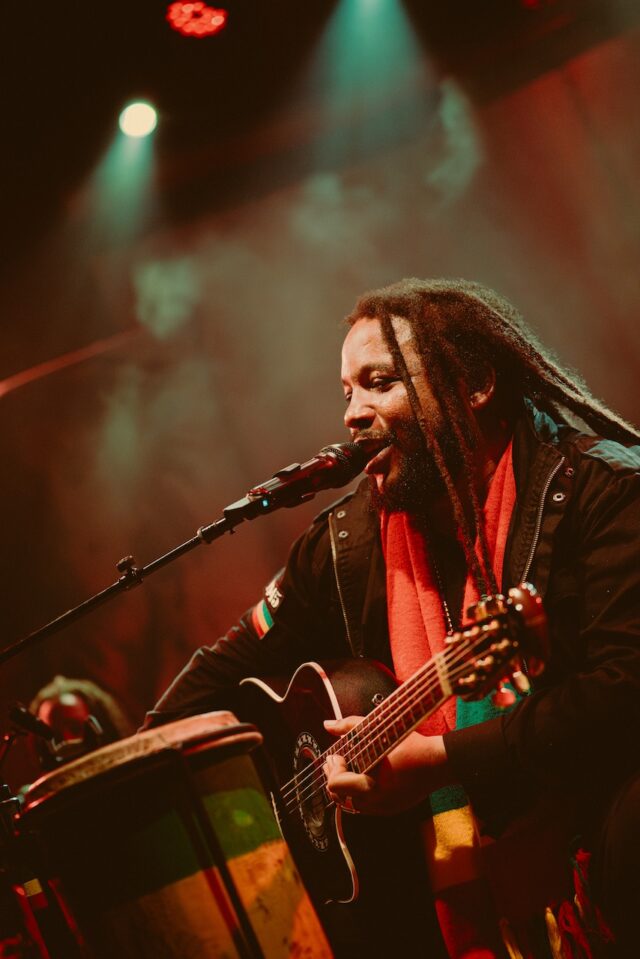
Stephen Marley’s lilting, meditative new single, “Hills of St. Ann,” carries the weight of a lifetime—ancestral and recent. “Other than my father being from St. Ann, that is where my son is laid to rest,” he says simply.
Joseph “Jo Mersa” Marley died on December 26, 2022, in Miami at 31, from acute asthma complications. The loss saturates every note of the single, which is as much elegy as celebration: St. Ann holds both his father’s origins and his son’s final resting place.
Speaking from his studio in Jamaica, Marley is deep into his next project: executive-producing a collection of songs celebrating the culture and roots of his homeland, with contributions from Damian Marley, Sean Paul, Shaggy, Protoje and others. “I want the listeners to feel my love for St. Ann and the history that is there with my family and myself.”
It’s his first new music since Old Soul (2023), a stripped-down acoustic album born of pandemic-era isolation—just Marley, one guitarist and an engineer—and a deliberate departure from the produced sheen of earlier hits like “Hey Baby,” off his Grammy-winning 2008 debut album, Mind Control, and “Medication.” He’s philosophical about the contrast. “It always starts from a stripped-down element of just you writing a song on the guitar,” he says. “It always starts from a simple form. Just keep it simple and organic.”
That simplicity extended to some unexpected creative detours. Old Soul includes a cover of his father’s iconic “I Shot the Sheriff,” with guitar work from Eric Clapton, who had a hit of his own with the song in 1974. There’s also a sunny, reggae-laced take on Ray Charles’ “Georgia on My Mind”—which, he told NPR, originally featured Marley singing “Jamdung on my mind,” until the Ray Charles estate requested he restore the traditional lyrics.
Ask Stephen Marley how he defines his own musical identity—separate from, yet in honor of, the most powerful legacy in reggae history—and he won’t take the bait. “There’s no separating,” he says. “I am a fruit from that tree. You can’t separate the fruit from the tree.” He hasn’t spent his career trying to step out of his father’s shadow so much as growing deeper into his own roots. “I’m just a lover of music. I was born into a musical family, and that helped to highlight that aspect of me. It’s in my DNA. Music is a talent that God gave to me, and that’s how I express myself.”
That expression has shaped not just his own recordings but those of his entire family. A multiple Grammy winner—nine at last count, many for producing his siblings’ work—Marley has served as one of the primary keepers of the family sound for decades. He’s modest about it. “It’s not a conscious effort. It’s just who Steve is to the family. No one imposed this on me or said you have to be this. That’s me.” And like any great producer, he knows a record is never truly finished. “At some point,” he says, “we just get it out.”
Reggae has always carried a frequency the rest of the world is only beginning to tune in to. Long before wellness culture discovered plant medicine, intentional living and the healing power of community, Rastafari was already there. It’s a shift Marley has watched unfold. “We talk about that a lot,” he says. “Even as simple as some of these plants that are now so important to others—we have always traditionally used them. Not just in reggae but in the islands. It’s a full circle thing, very much so.”
Does he feel a greater sense of responsibility, then, in the music he releases and the stages he takes, at a moment when the world feels so fractured? “It’s always been that for us. Reggae bears that weight. It’s just a part of us, a part of that island and the music that we make.” But something about right now feels different, he says. “There are a lot more distractions today, so the necessity becomes greater to put this music out—to have a balance out there that one can go to and find positivity and hope and enlightenment.”
The Jamaica Tourism Board project currently occupying his studio hours is a love letter to the island in the form of a collaborative album featuring some of its greatest voices: Damian Marley, Tarrus Riley, Sean Paul, Mojo Morgan (of Morgan Heritage), Shaggy, Romain Virgo, Tessanne Chin, Protoje and more. “We are just highlighting our island and paying tribute to our island,” he says. Asked what he personally loves most about Jamaica, he takes a pause to consider. “It’s just this place with this natural vibe—I don’t know if I can explain it in words. Bob Marley came from Jamaica. Burning Spear comes from Jamaica. Toots Hibbert came from Jamaica. I would say it’s a land of heroes.”
He brings all of that to East Hampton’s Clubhouse on July 17, where he’s played before and clearly relishes returning. “East Hampton is one of those places I love singing,” he says. “There’s always a good vibe there.” For the audience, he has a simple wish: “I hope people will be enlightened, lifting one’s spirit and give them hope for humanity.”
Explore more in Entertainment at The Purist.
Never miss an issue—join The Purist community.