







 By Cristina Cuomo
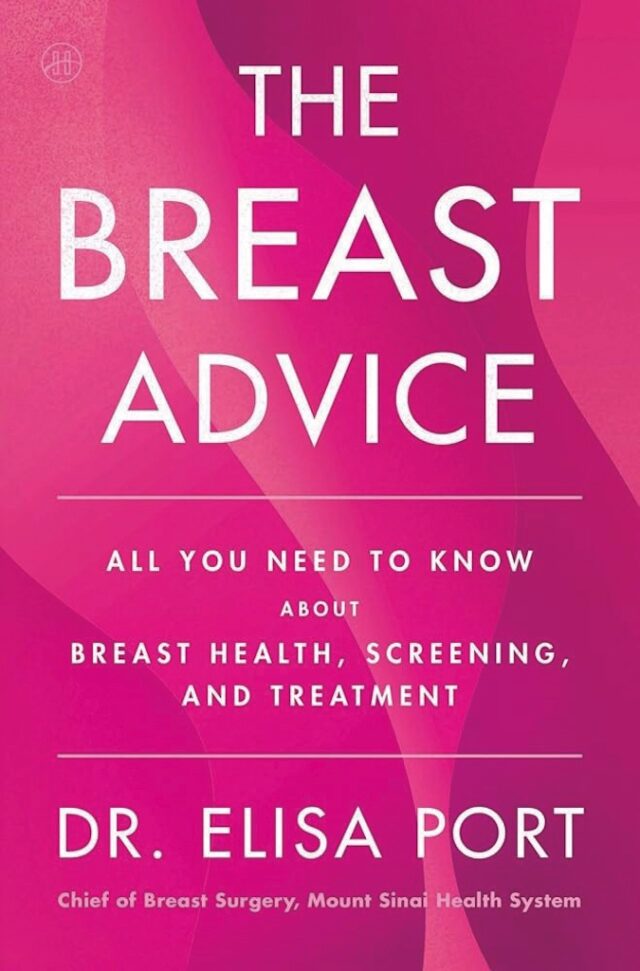
Dr. Elisa Port has spent over 25 years operating on breast cancer, and just as long fielding the questions patients ask in the exam room but rarely hear answered in full. Her latest book, The Breast Advice: All You Need to Know About Breast Health, Screening, and Treatment, is her attempt to close that gap—a plainspoken guide to risk, screening and treatment, built on the real cases she’s managed as Mount Sinai’s chief of breast surgery. Purist sat down with Port to work through some of the book’s thorniest chapters: birth control and cancer risk, the murky math on full-body scans, and why she tells patients to be just as skeptical of holistic cures as they are of anything a pharma rep hands them.
PURIST: What lifestyle factors can reduce breast cancer risk? Does birth control?
DR. ELISA PORT: The two main lifestyle factors that can decrease breast cancer risk are maintaining a healthy body weight and minimizing or eliminating alcohol intake. Long-term use of hormonally based birth control does increase breast cancer risk. The increased risk is quite small, but it does have an effect, and the longer one is on birth control medication, the higher the risk.
When should you do a screening?
Screening should be individualized, and should be based on risk for breast cancer, with those at increased risk perhaps starting earlier and getting more than just a mammogram. The general guideline for those at average risk is to start mammograms at age 40 and continue yearly after that. We often recommend adding sonograms or ultrasounds for those with dense breasts, which can make cancer harder to detect on a mammogram—in the 40- to 50-year-old age group, almost 50% of women may have dense breasts. We may also add MRIs to a woman’s screening regimen if her risk is significant. The book has chapters on each of these—mammogram, sonogram, MRI—which can help a woman navigate and determine when she might want to do these tests, how frequently, when to start early and how to assess risk. When it comes to screening, there is no one-size-fits-all, and it’s important for women to know what tests they should be getting for screening, and how to advocate for themselves.
How do you assess your own risk?
Risk assessment involves knowing your own risk factors. These can involve genetic predisposition, family history and many other factors. Getting genetic testing is one way to find out if you are at very high susceptibility. Another is to use a breast cancer risk calculator, an online tool, to assess ballpark risk. Importantly, these risk models can both overestimate and underestimate risk, and I have had patients come into my office with printouts of risk estimates that they did themselves or their doctors did with them, that are not reproducible. When I run their model, the numbers are completely off. This can result from family history factors that are inaccurately entered into the model that either overestimate or underestimate risk, or lack of understanding about prior biopsies one might have had, and the results from those biopsies. High risk for breast cancer is defined as 20 percent or higher. The average woman’s risk is 10-12 percent.
What about hormone replacement therapy? What happened there, and did it set breast cancer rates back?
Hormone replacement therapy (HRT) is a critically important tool for women suffering from menopausal symptoms. The usual regimen is a mixture of estrogen and progesterone. But here’s the tricky part: that combination does increase the risk of breast cancer. The increased risk is quite small, a percentage point or two, but it does grow further over the amount of time and number of years that one is taking it. Estrogen alone, also called unopposed estrogen, does not increase the risk of breast cancer; however, it does increase the risk of uterine cancer, and is therefore rarely prescribed by itself. Most important here is an individualized approach. Women who have not been diagnosed with breast cancer are candidates for HRT to combat menopausal symptoms, and even with the increased risk for breast cancer, a woman can consider it, weighing the risks and benefits to her as an individual. What we can’t do is tell women there is no added risk. The book goes through all of these options related to hormone replacement and how to navigate them.
So much has changed. One chapter is called “Chemotherapy”—what does science and intuition tell you about that? How is the medical system working to individualize treatment and scale it down?
The theme of de-escalation—trying to dial down treatment and spare people its toxicities—plays prominently in the type of care we give today for breast cancer. We have better tools than ever before to understand who does and does not need chemotherapy, and who does and does not benefit. This is a huge advancement: sparing women the toxicities of a treatment they wouldn’t even benefit from, while making sure that women who do need it, get it. The same goes for radiation and surgery—there are so many ways we’ve figured out how to safely scale back. These efforts are all backed by serious, rigorous research trials conducted over the last decades, thanks to dedicated researchers, doctors, and patients.
Everyone thinks there is a financial incentive to treat cancer. What do we need to know about what oncologists are trying to do with research, surgery, etc.?
Critically important to getting the best cancer care is making sure that a doctor—any doctor—is not financially incentivized to advise for more or less treatment: a double mastectomy instead of a smaller lumpectomy, chemotherapy versus no chemotherapy, and recommendations for or against radiation are all examples of ways doctors can be pushed toward more aggressive treatment than what might be needed. Doctors employed at most major academic medical centers, like myself and my colleagues, do not have any financial incentive to give more or less treatment, or perform more or less aggressive surgery.
There’s a chapter about full body screening. One patient says it saved her life, and another says don’t do it, it almost ended her life—talk about that.
Full body scanning is a new area of cancer screening that has taken hold. There are pluses and minuses, as with every test. In a very small percentage of cases, a new cancer will be discovered that might be lifesaving because of early detection. Of course, we all hear these stories, which are so profound and get a lot of attention. Here are the facts: The likelihood that a full body scan will pick up a cancer in an otherwise asymptomatic person is approximately 1 percent. That’s the benefit. The downsides are the expense—a few thousand dollars, an amount many can ill afford—and the high number of false positives. These scans do find things other than cancer, and when we’re not sure what those findings are, which is often, we have to do additional tests, and even invasive biopsies or surgery, to find out if we’re dealing with cancer. Even when no biopsy is recommended and “follow up in three months” is the plan, the anxiety and uncertainty during that time can be unbearable for some people. Lastly, please know that a full body scan doesn’t in any way replace standard, tried-and-true screening tests. A mammogram is far better and more detailed at picking up breast cancer, and a colonoscopy is far better for early colon cancer detection. The book chapter on this, as well as on liquid biopsies and other blood-test screenings, describes all of the pluses and minuses if you decide to go down this path and explore these newer options.
Let’s talk about a holistic path to treatment. Ivermectin, does it work? Lidocaine trials—is there any data and science out there?
When it comes to “holistic” or alternative therapies, be as skeptical about them as you are about mainstream treatments. Many people turn to alternative therapies out of fear of side effects, but supplements, vitamins and any substance that’s biologically active will have side effects too. Nothing is all good and no bad, whether you ingest it, inject it, or apply it as a cream that gets absorbed. So my advice is to ask whoever is recommending it—a doctor, a friend, a colleague—“What are the side effects?” If the answer is “none,” or you get a blank stare, walk away. It means the thing they’re selling probably hasn’t been adequately studied, trialed or evaluated to fully understand what you’re getting and not getting, and the harms and side effects that may come with it.
The Breast Advice: All You Need to Know About Breast Health, Screening, and Treatment is published by HarperOne, an imprint of HarperCollinsPublishers.
Explore more in Health at The Purist.
Never miss an issue—join The Purist community.