








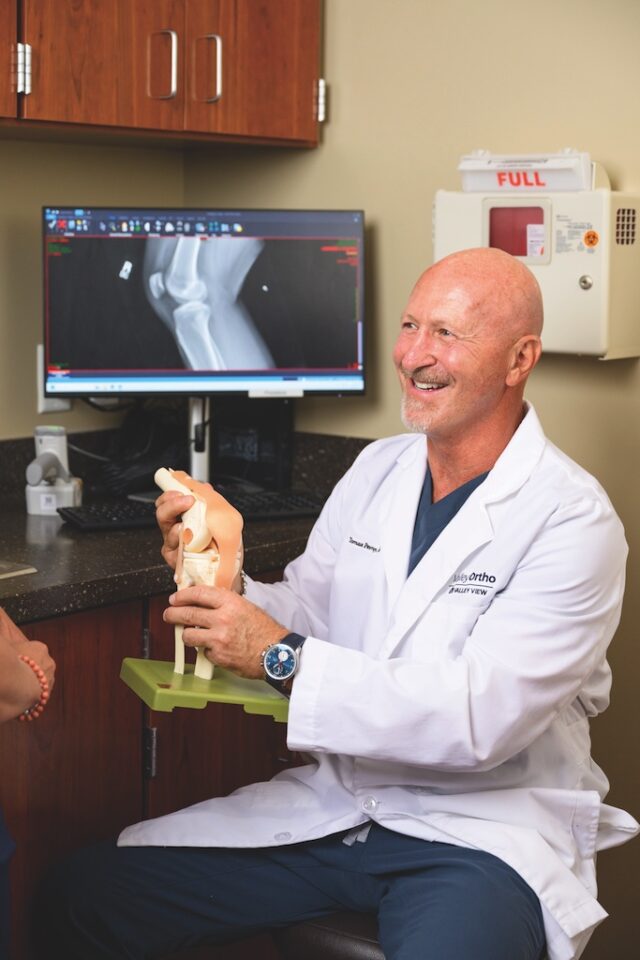
By Ray Rogers
PURIST: What has changed most about knee replacement surgery during your career, and what made you want to add the Jiffy Knee to your practice this year?
DR. TOMAS PEVNY: So much has improved in the past 30 years. Today we use robotic-assisted surgery, which allows us to personalize surgeries for each patient based on their unique anatomy and diagnosis. But what’s most exciting to me is how much the patient experience has improved. When I started practicing in the ’90s, patients had to stay in the hospital for several days after a knee replacement. Today, most people can go home that same day or after one night, and their recovery is quicker and less painful. Deciding to add Jiffy Knee to my practice is right in line with that—it’s an advanced technique that ultimately benefits the patient and helps them get back to what they love sooner.
In plain terms, what is the Jiffy Knee, and how does it differ from a traditional total knee replacement?
The Jiffy Knee is a muscle- and tendon-sparing approach to total knee replacement. The main difference is how we access the joint. During a traditional knee replacement surgery, the surgeon must cut the quadriceps tendon to expose the knee. With Jiffy Knee, we use specialized tools and techniques to work around the quad—we don’t cut any muscles or tendons. Preserving those soft tissues reduces pain and swelling after surgery and supports a quicker recovery. Patients can typically be up and walking within a day of their surgery, and they have the mobility needed to start physical therapy within a couple of days.
Who is a good candidate for the Jiffy Knee?
If you’re a candidate for total knee replacement, you’re likely a candidate for Jiffy Knee. That means patients with advanced, bone-on-bone arthritis who haven’t found relief with other treatments. Here in Aspen, we see so many highly active, athletic people who don’t want to give up their lifestyle for a long and painful recovery. Jiffy Knee is a big draw for that community.
Some of your patients have cryoneurolysis about two weeks before surgery. What does that treatment involve, and why do it ahead of time?
Iovera° is a targeted cold therapy. We apply cold as a nerve block to temporarily “freeze” pain signals in sensory areas around the knee. It’s safe and gradually reverses over time.
What does a realistic recovery timeline look like, from walking to driving to returning to sports?
Everyone’s different. Jiffy Knee patients generally begin walking with assistance within the first day or two, and unassisted within two weeks.
With continued strengthening exercises, both knee strength and function should dramatically improve after three months; patients slowly return to recreation during this time. At six months to one year, they can expect to be fully recovered.
What can someone do before surgery to set themselves up for a faster recovery?
ValleyOrtho practices what’s called “prehabilitation” in addition to rehabilitation. It’s all about preparing your body in the weeks leading up to surgery. That means getting the right strength exercises in, eating a well-balanced diet, managing any medical conditions and getting a plan in place for once the patient is home.
What’s your best advice for keeping knees healthy through a lifetime of skiing, hiking and riding?
Keep the muscles around your knees strong—that will help absorb shock and keep the knee stable. Maintain a healthy weight and eat right. Be sure you’re using good form with any activity. Above all, try your best to just keep moving.
Tomas Pevny, MD, is an orthopedic surgeon and sports medicine physician at ValleyOrtho, part of Valley View. He sees patients in Aspen and Willits and performs surgery in Basalt and Glenwood Springs. 970.925.4500; vvh.org/valleyortho
Explore more in Health at The Purist.
Never miss an issue—join The Purist community.