








By Ray Rogers
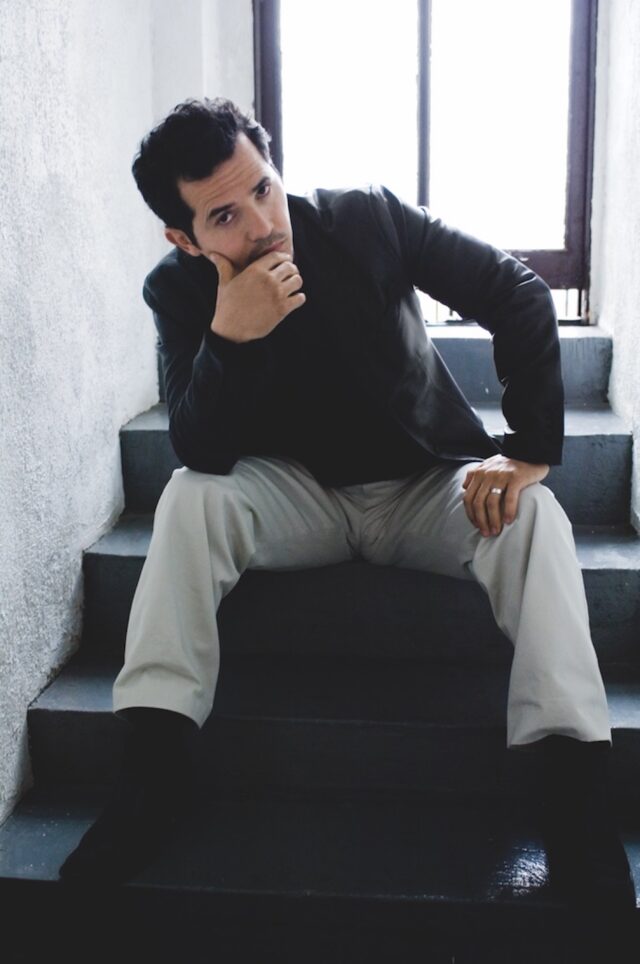
John Leguizamo looms large on IMAX screens across the world this summer in Christopher Nolan’s blockbuster The Odyssey, but right now he’s got his hands firmly in the earth, tucking echinacea, lavender and climbing clematis into the full-sun garden beds around his family home in Amagansett. The Tony Award-winning creator of Latin History for Morons and Freak—and who portrayed Tybalt in Baz Luhrmann’s Romeo + Juliet, Toulouse-Lautrec in Moulin Rouge!, Benny Blanco in Carlito’s Way, and four decades’ worth of characters who lodged themselves permanently in the American imagination—Leguizamo brings the same kinetic energy and irascible wit, sharpened by decades of political satire, to everything he touches. It’s matched by an equally powerful instinct to nurture: gardens, history, community, his own daughter onscreen. Leguizamo has always moved between the monumental and the intimate, and today he has a $250 million epic in theaters and a small, intensely personal indie, Bullet Catch, on the horizon.
PURIST: The Odyssey is ultimately a story of a man stripped of everything trying to find his way back to himself. What did working inside that myth stir in you, separate from the scale and spectacle of the production?
JOHN LEGUIZAMO: Loyalty was the biggest thing that hit me. When Chris Nolan and I met for lunch, he told me that my character, Eumaeus, was the most loyal character in Western literature—and that influenced everything I did. The whole story is threaded with it. Telemachus is loyal to his father, while the suitors are not. Penelope is loyal to her husband, even with no proof he’ll return. Even the dog, Argos, is trying to stay alive long enough to see his master again. And Odysseus himself breaks free from Circe and Calypso because of his loyalty to family, to his wife, to his son, to his people.
Why did this feel like the right story for right now?
Because humanity goes through cycles and we have such short memories—periods of great war and destruction, and then hopefully we come out of them better. I loved all of Nolan’s choices. The casting, the language, the script—it feels modern, of the moment. And loyalty is such a complex force right now. It can be a positive thing, or it can be weaponized—mobsters extracting loyalty, certain people in office demanding it as payment for transactional ends.
You went directly from this massive production to a more intimate indie. What did that contrast reveal to you?
Even on The Odyssey, Nolan functioned like an independent auteur. He stands behind the camera—he doesn’t disappear to video village. That matters so much, because the monitors don’t tell the story of what we’re doing internally. If you stand behind the camera, you’ll see it in our eyes. An indie film is usually like that by necessity—there’s no time to check your phone, it’s a sprint and you have to be completely present. Theater and indie films are my soul food. They remind me of why I became an artist.
In Bullet Catch, you play a father trying to repair a fractured bond with his daughter—and you’re doing that opposite your real daughter, Allegra. How did that shape the experience?
I had seen Paper Moon, and it gave me confidence—what a vital piece of filmmaking that is. My daughter is in her 20s, and it was a beautiful thing to share this with her on camera. But the relationship in the film is fractured, it’s in conflict, and we had to say very unkind things to each other. I didn’t realize how much it would sting. I know we’re acting, but hearing my daughter say she never wanted to see me again—it just hurt. You could feel the crew on pins and needles. My daughter teared up. I was in tears. She is so talented and so real that it was almost overwhelming. I loved the script. David Baram is a brilliant director.
You’ve spoken about the weight of growing up in survival mode and the toll it takes across generations. What does your own path toward peace look like?
You have to find your pockets of it—your oasis, your moments. Kids who grow up in the inner city carry the kind of PTSD associated with combat veterans. So, you learn to self-soothe, to self-care. In this industry especially, you have to figure that out, or the unnatural highs and lows will destroy you. I meditate, and meditation is my way of praying without organized religion.
Shakti Gawain’s Creative Visualization changed my life—I read it in the ’90s, and it was my real introduction to meditation. I tried to pass it on to my children like it was a religion. And last year I went to Kyoto with my son, and we did a samurai retreat where they taught us to meditate with eyes semi-open. I’d always meditated with my eyes closed, so that was a revelation. Walking is another one—when I work out, I try to use it as meditation. You need time with your own thoughts.
You’ve spent years reclaiming Indigenous and Latin American history, from the origins of agriculture to the culinary staples the entire world takes for granted. Why is reframing that history so essential, and what does reconnecting with it give you personally?
You grow up as a Latin person in America deluged with white culture and white history, and it’s not a two-way street. You’re not learning your own history either. Johns Hopkins did a study finding that 87 percent of Latino contributions to the making of America are absent from history textbooks. That’s a profound disservice—not just to us, but to the country.
When I started doing the research, it was so powerful: You get your sense of self from knowing where you came from. Our Indigenous empires were larger than anything in Europe at the time and more civilized in many respects. What undid them were the 32 plagues that colonialism brought. And the colonial project is deliberate destruction—they burned 5,000 codices, destroyed universities, religion, language—because if you feel insignificant, you can be controlled. That legacy echoes into the present. What’s happening to Latino and Indigenous bodies in this country right now is heartbreaking. And yet, we hit a milestone last year, contributing $4.4 trillion to the U.S. GDP. And what do we get back for it?
After everything—the one-man shows, the films, the advocacy—what still genuinely excites or unnerves you about what’s ahead?
What excites me is the possibility of working again with Chris Nolan and Mike Flanagan and David Baram. Working with a filmmaker a second time is such an opportunity—you have a shorthand now, you know what you love about each other and you can give more. The second time with Baz Luhrmann, Brian De Palma, Spike Lee—it was even more joyous every time. What I dread is the corporatizing of the studios and the media. The dismantling of 60 Minutes is a profound moment in American history; we can’t pretend otherwise. We have to seek out independent media. We can’t rely on corporate structures that have their own interests to protect. That, to me, is the real threat. Not AI. The hollowing out of institutions that hold power accountable—that’s what keeps me up at night.
What’s your life like in Amagansett when you’re there?
When I first moved to the Hamptons, I wasn’t sure about all that hoity-toity culture. But then I realized the majority of the people actually doing the work out there—the building, the cooking, the cleaning—are Latino, from every different country. I found my community. We have Colombian restaurants, Ecuadoran restaurants, Mexican restaurants. I feel like I’m in a little Latin country. And then of course there’s the beach—jumping into that cold water every day is just so refreshing. And I garden obsessively. At my brownstone in Manhattan, it’s all shade, so I do hostas, astilbes, bleeding hearts, Japanese forest grass, hydrangeas. At the beach it’s full sun: echinacea, lavender, catmint, clematis, roses.
What does working in the earth do for you?
It connects me to the seasons and the weather. Even a rainy day becomes a gift—the plants are getting what they need, and tomorrow there’ll be fresh growth. They say there’s a hormonal change when you put your hands in soil, an endorphin release. I believe it, because you just want to keep doing it. You put bare roots into the dirt, and you nurture them and pat them down. There’s a give and take. They give me beauty, and I give them care.
Explore more in Entertainment at The Purist.
Never miss an issue—join The Purist community.