








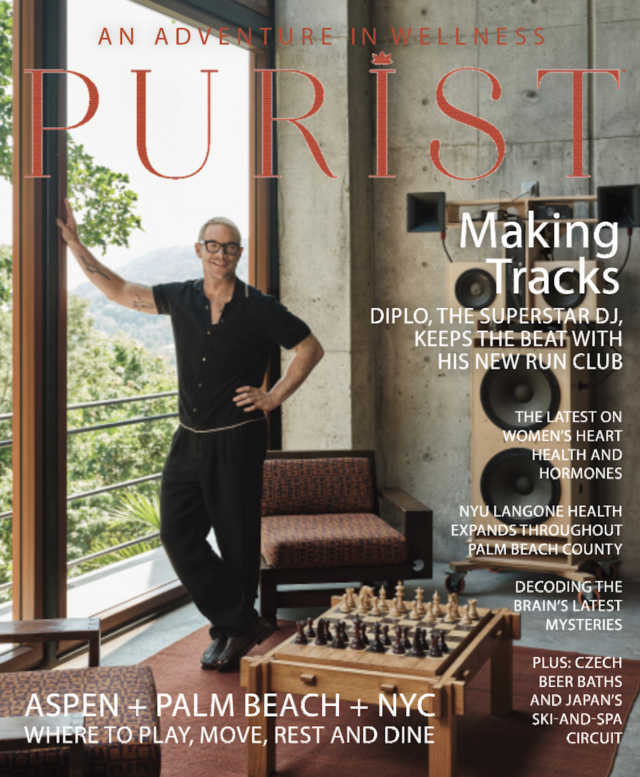
 Cristina Cuomo: Let’s begin with the Run Club. I know you started it after you ran the Miami half-marathon. When did you realize running was something you wanted to share, and not just do?
Thomas Wesley Pentz Jr., aka Diplo: Even before I started being the running DJ influencer guy, run clubs were big, mine especially. I just think most people when they reach their 30s and 40s, they try to enlist in triathlons, or Iron Man. Trying to do a marathon was just another thing I could do. This is our third season doing the Run Clubs, and it’s our busiest one yet. It’s definitely a multigenerational event. My running club—especially now that I can see the audience—is everybody. It’s moms, a group of divorcees, a group of kids who go to my son’s high school. There are dancehall fans. For a lot of people, it might be their first time running. At least 10 percent of the crowd have their hands in the air. Probably the coolest part is that it has instigated a lot of people’s entry into fitness.
Runners leave you lots of notes, and you said that you’ve read most of them. One in particular is from a 47-year-old Iraq veteran, who wrote that he ran as a way to cope with PTSD. And a mother wrote that her son was diagnosed with cancer at 14 months, and that your music kept her head above water, which is so beautiful. What goes through your head when you read those notes? Is there one that’s stayed with you?
A lot of people think it’s a novelty to go to these races, but it’s crazy how much of it is meaningful to people. It’s a community. It’s not a night where you have to dress up nice. You don’t have to buy a table, and you don’t have to be into what’s happening right now. It’s a bunch of people that your energy is feeding off, a positivity.
The first couple of times, I ran with people in the front, and then I started to just slow down. I tried to have a personal best, but now I slow down and talk to people. I go to the end, where people are walking, and I hype them up. My favorite part of the race is being there to say hi to everybody.

What does running give you that a festival main stage doesn’t?
It’s just my body, my mental health. Every day relies on me being outside doing something, some activity. I’m going to go outside in a minute and maybe walk my turtle.
What’s your turtle’s name?
I have two. One is named Hank and he’s big and annoying. The other, named Turbo, lives in the house and he’s begging to be let outside all the time, so I’m going to take him outside. He’s small, maybe 7 inches head-to-toe. Hank I got on Craigslist. I guess he was a rescue turtle because he’s big and he needs a lot of space. It’s kind of hard to find an over-50 turtle.
How long do turtles live?
They could live to be 100 years old, or older.
Humans don’t all necessarily go to 100, but that’s the goal with the Run Club. You have to read Born to Run, a history of running by Christopher McDougall. As a runner, you are going to love this book. So, you’re coming back to Belly Up on Dec. 18 in Aspen. It’s a small room for you probably—450 people. What makes that trip worth it for an artist who plays stadiums? What do you love about that small, mountainside community?
Honestly, I love that my kids can enjoy the winter sports I never grew up doing. They all ski and snowboard. Aspen is one of the coolest cities in the country, so I make it a whole trip where I can go do some work.
This year we went twice. We went for the Christmas party and then again for the Run Club in Denver. My kids got to see Aspen in the summertime. Then we flew to Machu Picchu [in Peru]. We were acclimated to the altitude, so it was perfect.

You like skinning up the mountain.
I can only do it once or twice, because I wake up kind of late. I’m not getting up there at 9AM, but it’s the coolest thing because I’m not a good skier. I’m more of a snowboarder, but walking all the way up a mountain, you make it really count. So, my favorite new sport is skinning. It can be sketchy going up the mountain; you can start sliding backward. It’s kind of crazy.
Do you visit friends when you’re in Aspen?
A lot of my friends have places there. Everybody from Kate Hudson’s family to the Goldbergs, who own Belly Up Aspen. When you visit, you go to one of those little bars and end up seeing all the cast of Yellowstone, drinking pineapple juice or something.
Kate Hudson was on our winter cover last year, so you were in good company. She was playing at the Wheeler Opera House. I love to promote musicians because I have a daughter who is a singer. She just graduated from college. We go to a lot of shows together, and we’ve definitely seen you together. Where do you call home these days? Tell me about your Jamaican home, which looks absolutely beautiful.
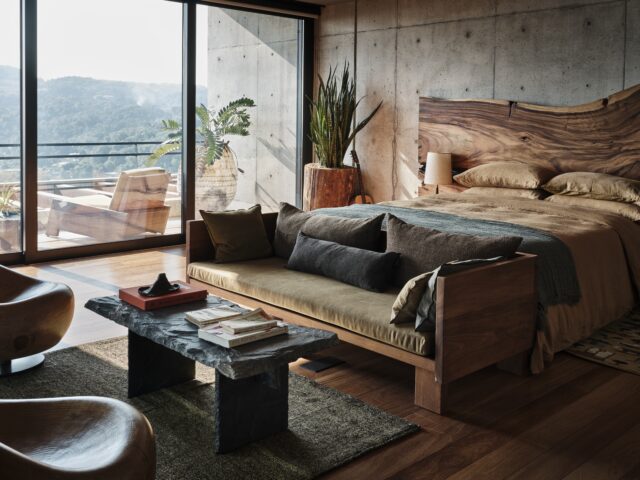
I’ve been working on music for 25 years now, on so many big projects, from the BTS album to Beyoncé’s Lemonade and doing Major Lazer and Jack Ü. Nothing comes close to working on something like the property I did in Jamaica, which is just like 4D art and music and everything together. With albums, you have a creative vision, art and the songs, but it’s still a linear project. Working on a property or architecture from start to finish takes so long. I did it the right way, with patience, and I would never do it again. It was probably my best creative endeavor I’ve ever done. On my farm, you can come work in a space for wellness, and that’s going to be very valuable. The more we are living these online lives, places like this one are going to be really special. While people are shifting so much with the internet and the AI, this is where the value is, the human side.
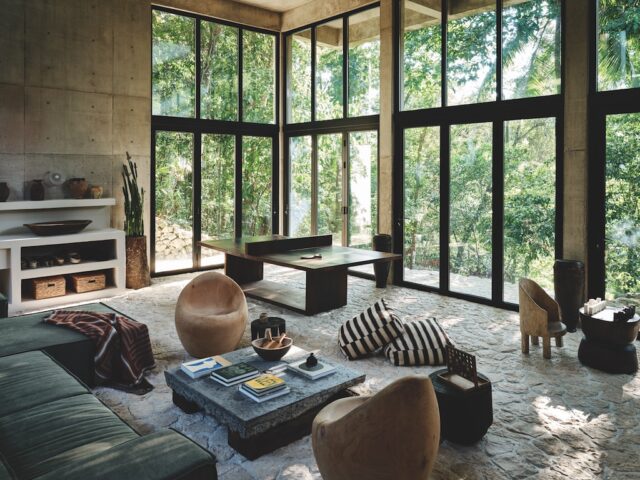
Your Jamaican home, designed by Freecell Architecture and Gia Wolff, is built around the jungle and the light.
Gia is an old friend of mine. She did some renovations on my house in Beachwood. I loved her ideas. They were just so cool and clever. We had the same interest in brutalism, Brazilian architecture and Mexican modern. She pitched me a couple of things, and they were just so on point. It’s such a crazy experience to be the middleman, watching them engineer this for seven years. They micromanaged everything to another level that drove me insane, but it was so worth it to make sure the thing got delivered how it was supposed to be. It was really a testament to patience. Don’t take shortcuts. It really matters in the end.
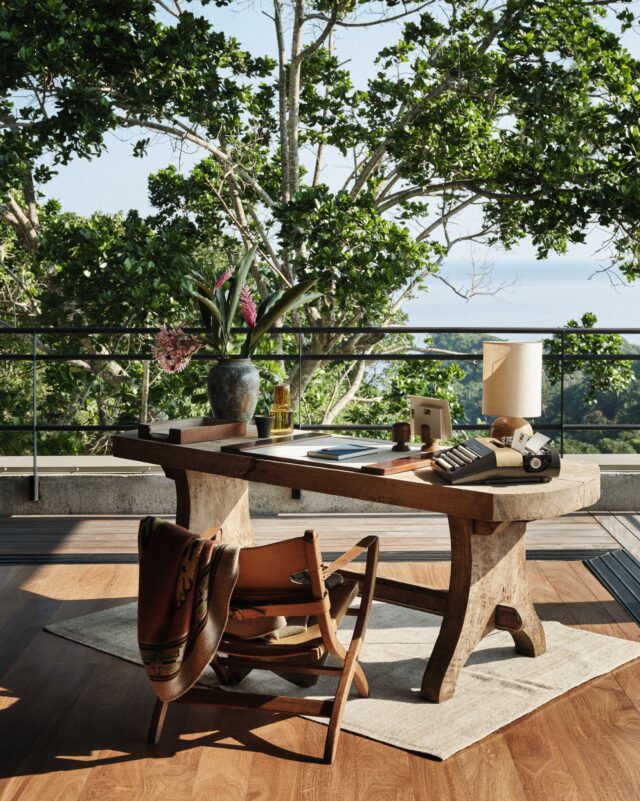
That’s why there are so few LEED Gold-certified homes. There should be a lot more, because every step of the way you have to certify them, and people don’t want to wait. What’s your favorite room in the house?
My library, because it’s just so weird. One side is all the books and the vinyl and the records that have been collected in Jamaica over the past 10 years. The other side has one glass window with a view of the jungle. There are midcentury furnishings. It’s just a different space. I go there all the time, sit there and chill.
Who are your musical influences?
The Clash’s Joe Strummer was one of my favorite musicians, because he had such an elaborate career from punk to industrial music, and in between he was doing disco reggae rock, and just so many things. One of my favorite records of all time is “Rock the Casbah,” which is a political message, and a mashup of dance hall and rock and punk. I’m a huge fan of Bob Marley and Alton Ellis—there are so many great musicians that came from Jamaica, players from Peter Tosh to dancehall artists like Vybz Kartel, Sean Paul. There are still things happening there that are super-influential around the world. One of my favorite people is Prince Jammy, who invented the dub. Back then they were just smoking a lot of weed and going crazy and adding dubbing and putting the bass lines in. I could go on and on about Jamaican music and music in general, because that’s where my brain is always at.
“Let Me Cook,” your new single, is the first track from a Run Club companion project. You’ve already debuted an unreleased track with Too Short and Kah-Lo at the San Francisco race. What makes a song good to run to, and what else is coming?
I made this EP specifically for running. This is a great place to hatch music—things that are just high energy, a fusion of hip-hop and house and whatever comes to my mind. “Let Me Cook” is a record you’re already hearing played at NBA games.
Twenty years in, what do you still want to do that you haven’t done yet?
Take a nap. Maybe I’ll do a sleep competition.
Do an app with sounds for sleep. Where do your best ideas come from now—the studio, running, a long flight, being in Jamaica, somewhere else?
Probably from a Pilates class, or some place where I have no phone. I get random ideas during a yoga class, or while riding my motorcycle. Those are places where there’s a big blank space, where things can happen.
For two decades, you’ve kept a punishing touring schedule. What’s changed in how you take care of yourself?
I really don’t think I take care of myself enough, but being alone is very helpful for me, whether it’s in the sauna or listening to podcasts. Whatever it is, I do like to have two or three hours alone every day, or just quiet time with people.
You’re a dad of four—from a 16-year-old son to a daughter who just turned 1. How is fatherhood different this time around?
Run Club has been bringing my family together in such a different way. Lazer, my 12-year-old, and Lockett, my 16-year-old, ran with me in San Francisco and LA. My 6-year-old, Pace, came to New York. They all find running fun, which they didn’t before. My dad and my nephews come, too. I always have at least 20 or 30 people with me on my runs, my friends and family. My own small community is getting bigger.
Explore more in Entertainment at The Purist.
Never miss an issue—join The Purist community.