








By Regina Weinreich
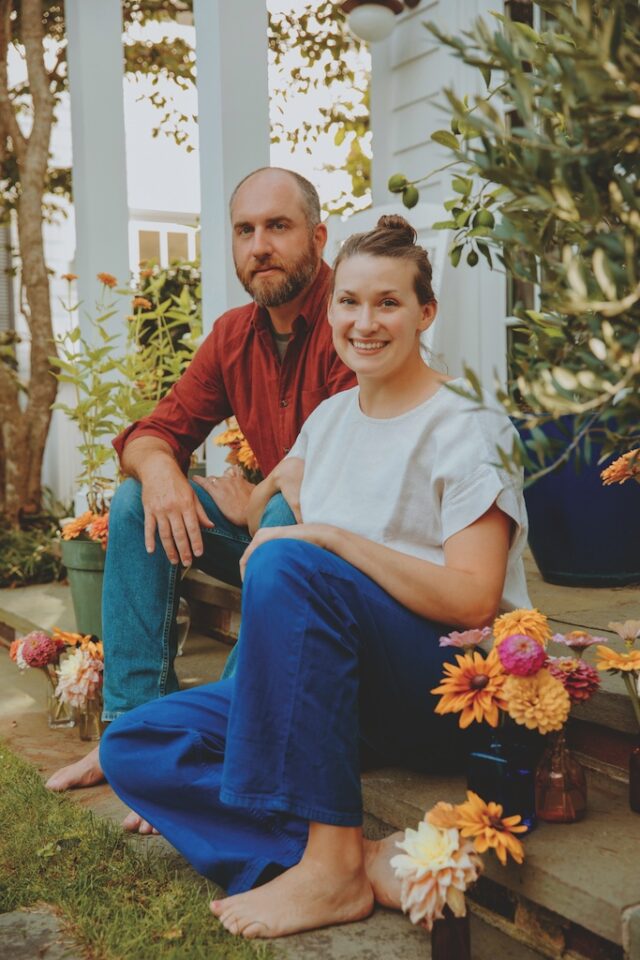
In the heart of Southampton, two artists make art together, and in separate spaces. Katie Whipple quips: “If you draw next to someone long enough, you can end up married with kids.”
She met Brendan Johnston in art school in Midtown Manhattan and fell in love; they started dating. “Painting together and going to museums and just being immersed in art. It’s hard to say how we influence each other now,” she says. Think: flowers and stone.
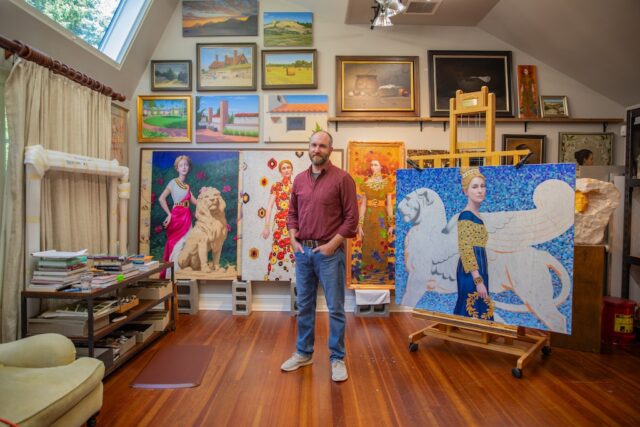
“I find the artwork through empathy with the materials, learning their language,” says Brendan Johnston, showing Purist around his Southampton studio, a refashioned garage in his parents’ estate. In his case, speaking to the variety of materials, the job is multilingual.
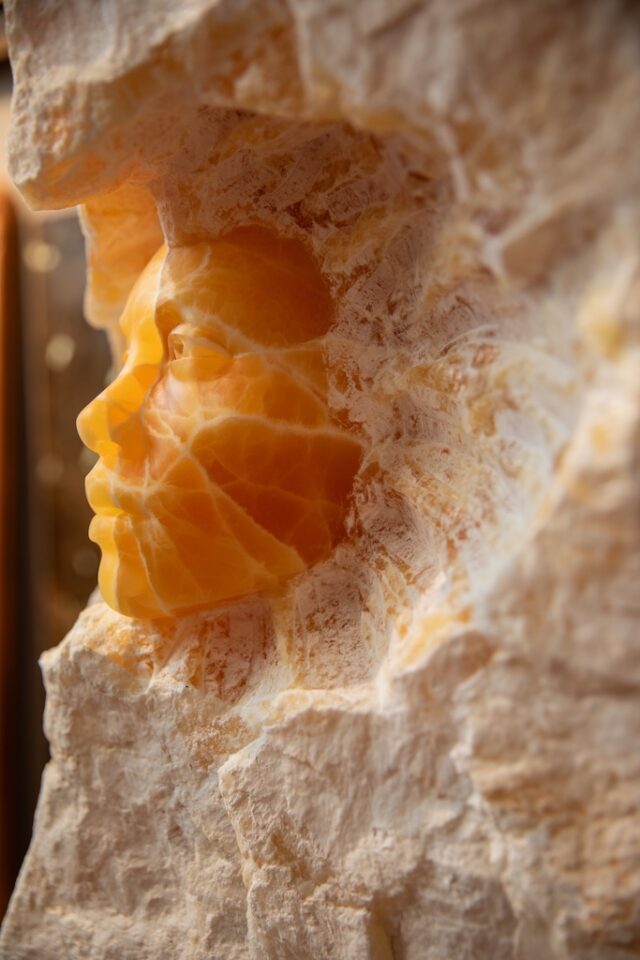
Old Master-influenced traditional landscapes hang juxtaposed with leaning large portraits on granite embedded with hand-cut tiles, alabaster and gold leaf. Chiseled busts sit on industrial shelves in a variety of stones, faces like those in classic Greek statuary set in rough, unfinished surroundings.
“There’s no material more beautiful than stone,” he says. “All made by Mother Nature over billions of years. Stone is the oldest ground for art: cave paintings, Egypt, Mesopotamia.”
His sculpture process is arduous, inventive, labor-intensive and risky. “Stone is purely reductive,” he says. “You can’t add or subtract as with clay. You must respect boundaries. For example, this piece of stone is called Norwegian Rose.” He caresses a smoothed facial cheek, mottled in pinkish red and white. “This was particularly difficult to carve, because the red is extremely hard, and the white is extremely soft. The challenge of working with irregular materials is paying close attention to how much pressure to apply with a chisel. Sculpting is an exercise in patience and precision.”
Johnston curates each stone, naming them and their properties: Picasso marble from Utah, Persian travertine, Grand Canyon onyx from Arizona, classic white Italian Carrara marble. He made a portrait of his son on a piece of Namibian sodalite from Africa. Beautiful, yes, and rich, and costly. “Copper leaf is not very expensive. Gold leaf is expensive,” he says. “Yes, the gilding is pricey, and the abalone is too. But for me, it’s worth it. I’ll go to almost any expense as long as I can try and get what’s in my head out.”
Aware of the rich history of abstract expressionism on the East End, Johnston acknowledges that his love for antiquity and early modernism comes first. “I love Jackson Pollock, Lee Krasner’s work, especially those 1940s, ’50s abstract painters,” he says.”I want to see how each stage feels to make. I haven’t gotten to abstract yet. I’m like an iceberg. My work is slow and meticulous, and my career is very slow and meticulous. As a creative iceberg, I don’t know exactly which way the current of the ocean is going to take me.”
Being nearby in Southampton inspires the journey: landscapes, 100 percent. He paints the flowering trees in the yard. When Whipple shared the studio space, flowers would creep into his work. Southampton gives them the space and the quiet, especially in the winter.
At Grand Central Academy (now known as Grand Central Atelier), Whipple won an award to stay at the American Academy in Rome. They lived in Italy for a year and did the grand tour, what artists used to do in the 19th century—visiting the great museums, and came back to New York. Each year they spent a month longer out East. “We wanted to be out here where there’s space, light,” he says. “Now we’re here full time.”
Recently, he became a board member at the Southampton Arts Center, a lovely honor, he says. He will help fill out their programming, teaching landscape painting there every summer.
While his studio is in the house his family built, with its “Southampton vibe,” he loves the historical structures, too. They bought an 1850s home closer to town, renovated by the previous owner. “We love that it’s old, and the interior layout is a little quirky.”
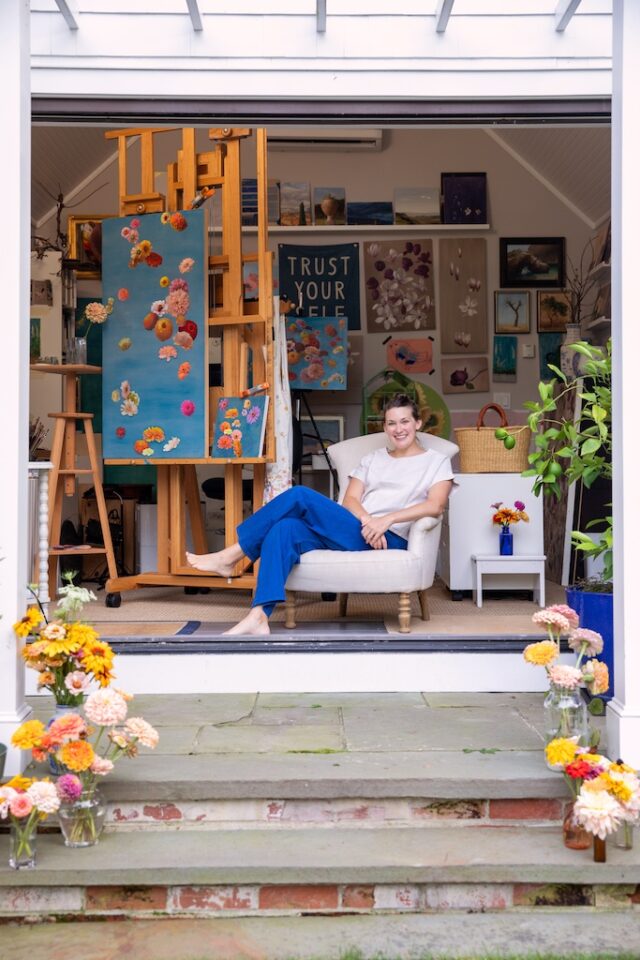
Katie Whipple’s studio is a converted pool house at this home, where they live with their children (ages 5 and 1) and a fluffy white Samoyed named Theo after van Gogh’s brother. Katie can work and look in on the children a few steps away. A self-styled painting nerd, she eschewed college for the atelier where they met.
Whipple grew up in Avon, in the suburbs of Indianapolis. “My mom was my first painting teacher, so I grew up painting my whole life,” she says. “In high school, I wanted to learn how to draw well. When I visited GCA, it was love at first sight. I need to be here now. I convinced my parents. I wanted them to know that I was serious and not just applying out of nowhere, showing up as an 18-year-old. Few students came straight out of high school.”
You have to really know what you want to pull a move like that. But with her parents’ support, it didn’t seem gutsy. “It felt so clear to me. That’s what I need to do, where I want to go,” says Whipple.
“As to Southampton, I purely married in,” she says. This is the place where she can cultivate her art—and the subject of her art. She grows the flowers she paints. A giant easel sits squarely at studio center, holding the work in progress. “My heart is in the flowers. The unfinished canvas is a commission. The client specifically asked for a colorful zinnia painting, in this size.”
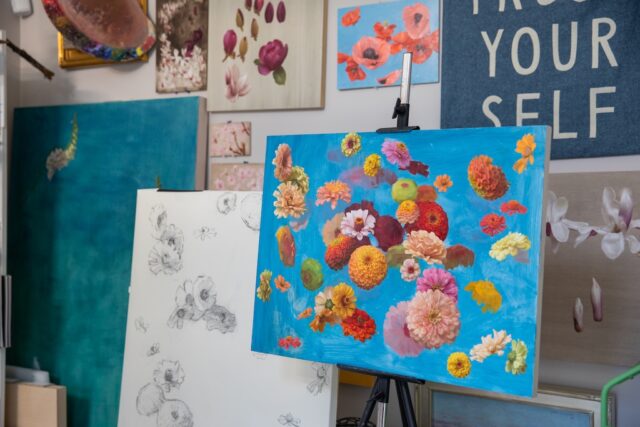
She curates the seeds as Johnston does his stone, “from different breeders all over the country to find interesting nuanced colors.” Whipple points to large beds in her yard. “The climate and soil here are amazing for growing things,” she says. “This is my third summer working on this project. I’m definitely going to miss it when it’s done.”
Saying goodbye, she offers a generous bouquet. “Everyone who comes leaves with flowers.”
Explore more in Culture at The Purist.
Never miss an issue—join The Purist community.